 |
| Coca-Cola - The Symbol of a Globalizing Economy |
And in turn, identity has been deconstructed and to a certain extent reconstructed in a totally new way. Nations continue to define most of us, but increasingly the globalizing economy is changing what identity means. And although it shouldn't be considered a problem to be a 'global nomad' type, it does impact on how some perceive their purpose. The cultural politics of the regions encompassing formerly glorious empires such as the Ottoman and Austro-Hungarian ones reflect this uneasiness of a 'Golden Age' which has long past. Other revolutions in the second half of the 20th century ousting symbols of monarchy or autocratic power have also contributed to the questioning of purpose - especially in the Middle East (Turkey, Afghanistan, Iraq, Iran).
 |
| Orhan Pamuk's part-memoir, part-homage to Istanbul |
“It’s not a matter of luxury, it’s a matter of loss of identity, loss of connections … and all the time seeing something really unusual and strange [unfolding inside Iran]."
This is not however an apology for the repressive measures taken by these powers which left their population with no choice but to herald a new era of government and political power. It is the cultural and social mourning which accompanies such paradigmatic shifts to a nation's character, and the uncertainty surrounding the renewal of such a country. Coupled with this national renewal, the pervasive character of a globalized economy makes this pivotal period of cultural and social development especially fragile.
It does not help that the study of international relations - despite its advances - still uses the nation-state as the standard unit of study. Thus it is important to take smaller case studies to demonstrate what uncertainty can be created in such renewal. In the next post, I will concentrate on Malaysia, its post-colonial development and the impact of its visa system.
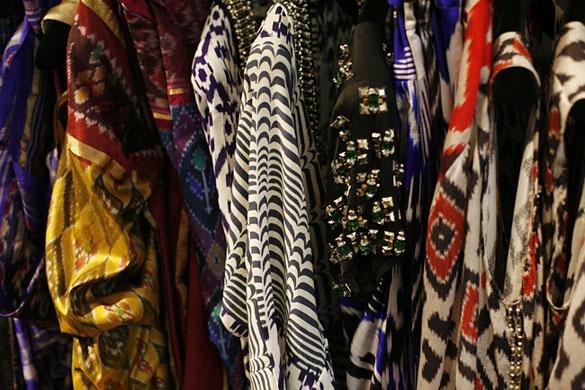 |
| The designs of Dries Van Noten: "Being considered and labeled a “Belgian” designer is an integral part of my story. It is something I wear with pride, lightly, and is in no way a burden. It is always more pleasant however when it is used to describe rather than “box in”. Maybe we have finally got “what we were wishing for…” Fashion is now a global phenomenon rather than simply a “national one”. The globalization of images and aspirations has gone a long way to making this the case." |


No comments:
Post a Comment