Fantastic book on recent psychological studies emphasizing the importance of the irrational/sub-conscious in our decision-making and how we develop as human beings, in priority of rational thinking. Here's a link to a review from the Guardian:
Recent events have shown how ...isms must be presented and articulated clearly. It is all too easy for these umbrella terms to be misused. 'Cultural marxism' and 'islamification' are among the terms which have been used with such astonishing ease that it is simplified into merely an emotional gut instinct.
As with any kind of debating, if you must argue against something, the strongest points of the opposing argument should be tackled. This involves searching the depth of the argument and the complexity behind it. It is all-too-easy to score that open goal.
Misinterpretation or the lack of critical analysis is also a regular symptom of our information age. The most ironic perhaps being the Norwegian killer's writings on Jacques Derrida. He acknowledges the concept of 'the death of the author', and the fact that literature can be twisted away from its original meaning, citing the emergence of feminist critical theory for example. But then he does not acknowledge his own twisting of history - what of Norway's historical development into one of the most open and tolerant societies in the world? His focus on the medieval past betrays his lack of attention towards the more recent past - after all, Norway is the home of the Nobel Peace Prize.
N.B. - The attacks in Norway were indeed barbaric but should not be merely described as the acts of a 'madman'. Mad men do not write about Antonio Gramsci in a 'manifesto'.
Susumu Shimazono's work on new religions (particularly Aum Shinrikyo - the organisation responsible for the terrorist gas attacks) in late 20th century Japan is particularly instructive in trying to decipher how such atrocities came about - the revenge of religion reacting to the disorientation of modern society, the apocalyptic/armageddon-like vision of the world (the need to start anew), the lack of trust in the public and political world, the role of highly educated individuals. This is not trying to condone or explain this barbarism; merely the conditions in which such mindsets could potentially emerge.
Perhaps this is all too obvious, but it is true that our judgment is somewhat clouded when different factors coincide with each other. It is also difficult given our personal affiliations, biases and preferences - however hard we try to suppress them. And it is especially easy for 'neutral' newspapers to influence us.
Whatever is in fashion at the time, the law will always hold some sort of certainty and stability - especially in criminal cases. To be presumed innocent until proven guilty; to be guilty beyond reasonable doubt - these foundations are essential. Why are these so essential?
Let us consider the recent case of DSK, the head of the IMF, and compare the situation of Julian Assange. The similarities - sexual offences, massive media coverage, cries of conspiracy. The prime difference - politics.
Although there is the added spice of cultural differences - the French 'seducer' and the Australian/Cyber-national nomad, we are sometimes instructed to think in a certain way due to our political beliefs. Is this the end of a creditable Socialist challenge in France? Or does this threaten the resurgence of technology-led anarchism?
But nevertheless, serious criminal charges must be investigated - the wider political milieu will have to wait or if it gets fed up of waiting, go on without them.
NB: This is not about the discipline of Law and Economics, as espoused by the likes of Ronald Coase or Richard Posner.
A more general discussion about the foundational basis of both law and economics is something much underestimated. Why? Because understanding the basics of law in different will change your outlook on economics, and vice-versa.
The most obvious examples are property and taxation. How private/common should property be? Strictly speaking we are not talking about people holding property, but people having rights over property. This would perhaps elude to the conflicts between the capitalist/communist economic models.
Furthermore, taxation is enshrined in law but is ultimately determined by economic conditions and government policy. Fiscal conservatism, libertarianism, economic liberalism - these are labels attached to economics which have a profound impact on not just financial regulation, but more fundamentally contract law.
Take the ideas of Andreii Schleifer, a Harvard academic, on the historic development of different legal systems. According to his research, the Common Law system has developed in such a way that the countries adopting it have become economically more dynamic and advanced compared to their Civil Law neighbours.
Not forgetting the complications of politics and the practical manifestations of international and national policy, it is evident that there is much to think about in trying to devise the structures that underpin our modern societies. It will be particularly interesting to see how emerging economies will try and develop their own law along with their own historic traditions - Islamic Law, Confucian School of Thought, and colonial influences but to name a few.
There is a problem in talking about a public consciousness when two juxtaposed events are not exactly cohesive in our understanding of the world.
The Royal Wedding had dominated the press for the best part of a week. Then suddenly, no photos of smiling Brits waving flags; replaced by the new story - the 'Osama bounce' that Barack Obama was enjoying.
Despite the enthusiasm on our screens, there was a quiet grumble from the republican minority. Was it surprising that American tourists were aplenty in the London parks? Who exactly are taken in by the pomp and circumstance of it all? In the party atmosphere, many of the questions of constitutional significance and the British soul were all but forgotten.
And for those who are not politically inclined, what does the death of Osama Bin Laden mean? It depends what you make of the Arab Spring I guess. Or perhaps whether you think the soft power idealism of Obama is more effective than those in the Kissinger school of realism or even the Leo Strauss school of neo-conservatism.
If the media had an overriding narrative, it may be slightly schizophrenic.
There has always been a certain hoarding element of the middle classes, but two forces make this an altogether different beast - globalization and financial technology.
Globalization is exporting the aspiration of the middle class to new territories, bringing them modern problems that many would have not anticipated. From the eternal problems of hunger and cruelty, different nuances are required to see ostentatiousness or materialism as just as threatening to happiness.
In emerging economies such as China and India, this is very much prevalent as disparities in wealth become wider and more visible in societies that have prided itself on spiritual/philosophical depth. Evolved over millenia, India is perhaps one of the most spiritual countries in the world, while Confucianism has long underpinned all that is great and cultured about China.
It is not much of a stretch to imagine these societies starting to contemplate in the oft-surreal, existential way that Japanese has raced through the modern age. After you have your assets comfortably protected by property and education, then what next?
But developments in finance will also exacerbate the position the middle class will find themselves in. This is because it is perhaps the natural tendency to securitise the assets (hard and soft) one already has. It is most recently evident in the Financial Crisis - with financial instruments taking advantage of the 'safest' asset there is: property. A few CDOs and CDSs later, sub-prime mortgages become front page news.
The next big bubble may come in the form of defaulting student loans, according to Peter Thiel. This is epitomised by the Harvard MBA being described by the Economist as a leveraged bet on someone becoming a finance director at a blue-chip company. Education becomes an asset, albeit a soft one, and a commodity which can be treated and marketed as such.
In safeguarding our own interests, we have quantified our most important social and capitalist values in a way that wider moral and cultural stability is at threat.
As an internationalist, it is with a sense of envy and confusion that I look upon those who are so proud of their country. It must be quite comforting to know that the nation is an unwavering part of your identity. But then again how limiting it is to not go beyond borders, as some forms of culture and finance have done so successfully.
This is why I do not take much interest in military affairs as it compounds the power of the nation state despite those alliances and regimes people attach a lot of importance to - e.g. the UN or NATO. But take the nation-state out of war for a second, the picture looks to me a little more interesting.
Cyber security
Protecting information and computer systems around the world has become paramount to national security across the world. Since the first proper 'cyber-war' in Estonia in 1997, attacks on government data systems have become more commonplace and threatening in the future. This may not be war as such, but it is one of the striking examples of how warfare is changing.
Drones/robots
Robots will be increasingly sophisticated in the space of our own lifetimes. Although drones are slightly different, it raises many ethical questions about the 'dehumanization' of war. Can an army officer remotely controlling a drone be directly responsible for those innocently killed by a drone they were controlling? To them, they are looking at a screen and pressing the red button to fire their weapons. Not dissimilar to a computer game I suspect. Perhaps there is too much psychological damage from infantry using bayonets in close-combat - such drones would save them from the emotional scars of physically having to kill another.
Private contractors
Possibly one of the most controversial areas of warfare is the hiring of private contractors for different kinds of military and security operations. I wonder if Reagan and Thatcher envisaged this development when they talked of de-regulation... But nevertheless, the traditional sphere of national governments have been replaced in some quarters by private security firms. By winning lucrative government contracts, private security firms have grown considerably in the last decade. Whether their operations have been properly regulated or controlled is another matter altogether. One can only take a quick glance at the Blackwater security firm changing its name to Xe; a great piece of re-branding to wash over scandals.
The developments above mainly concern developed states and do not apply much to war-torn states with less sophisticated means of military conflict. Child soldiers and guerilla warfare are the name of the game in some regions.
But even with this discrepancy between the means available to developed and broken states, it is hard to 'win' a war. It was perhaps bizarre for some to conclude when discussing the Pacific War that Japan were actually the real winners due to its economic transformation after the war. Equally, the real winners of current conflicts may change just as history is re-written in different ways.
Blue sky thinking or something a little more practical? People across the world have different processes and motivations in their lives, but many try to contribute towards making the world a better and more interesting place to live. Better and more interesting do not always coincide or overlap quietly, but it is clear that both imagination and frameworks are essential in this fragile relationship between creativity and practice.
Imagination
There are countless examples, but here I choose to focus on the infinity of the universe. Despite the Cold War background of the Space Race, for many people it opened up a huge realm of possibility about our planet and the rest of space. With 21st century technology, commercial trips offered by Virgin Galactic will soon make it possible for ordinary souls (with a bit of money) to enter space. Private enterprise is on the cusp of entering space. The longstanding TV series, Thunderbirds, was inspired by the possibility of man in space.
Space has further advanced the study of science, especially in the area of physics. The CERN Hadron Collider for example, has made the ongoing search for the Higg's Boson become a holy grail regularly discussed outside merely scientific circles.
But it seems most of our interests lie close to concerns a little closer to earth. Despite the physicality of sculpture, this mode of art has strived to reconceptualise our notions of art, and by extension the notion of ourselves. Henry Moore's "Reclining Figure" is an outstanding example of the power of sculpture in re-imagining ourselves.
The flowing figure tells us of the human being's fluidity. Although not directly linked to Sartre, its post-WWII background is evident in its assertion of the individual. Looking at the sculpture, you can interpret the smooth lines and curious arcs as you want. Thus you can also decide what you are yourself, without anyone telling you otherwise. It was also Moore's attempt to return to art's "pre-cultural", "pre-rational" origins. To imagine this in sculpture is exceptional.
Henry Moore's "Reclining Figure"
Frameworks
Development - there are an abundance of theories which population development studies, with many focusing on economics. Development economics is not within my understanding, but on the basic level of reconstructing countries from the debris of war and conflict, there are a few essentials.
One fundamental issue which is regularly misunderstood is institutions. Without the right institutions, a modern state cannot function. All these quite boring things such as the civil service, 'bureaucracy', army, national banks, courts and tax authorities - must be competent and accountable. Then can follow schools, hospitals and other aspects of welfare. Becoming 'institutionalised' has now become the way to say that you are 'no longer cool', but in the aspect of developing a modern state, it is both the 'hard' and 'soft' institutions which must be established in a developing country.
It is particularly interesting the re-building of some parts of Afghanistan that policing and rule of law have been emphasised in priority of development aid. No water pumps or generators just yet; "stabilization" seems to be the buzzword.
Despite the occasional tedium of the law, any legal system should protect basic rights of individuals - something that a number of emerging economies are dragging their feet on. This will gradually become a pressing issue for many countries in the Middle East, Asia and Africa - how to establish rule of law.
And finally, everyone's best enemy - free market capitalism. It is perhaps quite telling that only 30% in France agree that the free-market system is the best. Perhaps a German-based stakeholder model is better, or an economy with heavy state involvement. While I am not in the Chicago School of thought, I maintain that markets which are transparent and relatively free are important. The brutal number-crunching that accompanies the least-worst option that the West have chosen should not be accompanied by exploitation or abuse of the system - as is regrettably common in the modern age.
This is why a lot of work has been done following the ideas of Ronald Coase. Institutions, regulations and legal systems can make a fundamental difference in the way in which a free market model can work. This is none more so demonstrated when an absence of law means cynicism of capitalism ensues. The most prominent recent example is the debacle which has become BP's supposed tie-up with Russian oil giant Rosneft, and its continuing litigation with its joint venture partners in TNK-BP. Corruption and closed-door deals should not have a place in any kind of economics.
Politics
Sadly elite politics can get in the way of these imagination and frameworks, but for the personal politics that involve us, it is what spurs our contributions to the world.
The x in the title should be an x, denoting that this is an eternal debate discussed for centuries. This is my own minute comment on this topic.
My focus here is on museums in China, which have come into existence just as fast as the country's economic boom. With the current Chinese Communist Party's uneasy relationship with history, it is with widespread interest that one sees the construction and curation of museums in China.
It is important to note that museums as a concept is a Western idea, which expressed power, civilization and education. It was open specifically for the public to learn and be in awe of the displays and artefacts on display. A powerful tool and permanent place of learning if there ever was one.
Thus it is with these considerations in mind, that we curiously look at the newly renovated National Museum of China in Tiananmen Square in Beijing. Having recently re-opened, it displays the vulnerability of the ruling party about the past and how it should be narrated and presented. As a New York Times article states:
"It is also an example of how China finds it difficult to create cultural institutions that prove equal to its economic achievements."
Culture, as Habermas has traditionally put it, is all about a public sphere, which the public are essentially in control of. Although his concept has been rubbished to varying degrees, it is clear that the Chinese government has struggled to back away from Chinese culture developing its natural course.
The socialist aesthetics of the Soviet era are still prevalent in many of China's museums. The stark columns, the clean and geometric lines. And not to forget the sheer size of the museums themselves - the new National Museum is supposedly the biggest in floor area in the world.
But in terms of museums as an institution, they have always received significant public support and funding, especially in the U.K. Perhaps there is some implicit politicisation of museums in 'liberal democratic' countries too.
It is worth thinking twice when you next enter into a museum. Its architecture, atmosphere, design and perhaps its implicit politics. The study of museology - of which I knew little until a year ago - has developed in many different ways in the last 50 years, for example with the rise of 'eco-museums'. If ever there was a clash between culture and politics, the museum would definitely be a suitable venue.
Everything must be taken in context. The field of 'World Literature' adheres to this especially, as otherwise it may be difficult to understand the peculiarities which are obscured by the universality of themes that pop up in literature time and again, tragedy, love, revenge, family etc.
It is with this stream of thought that I put down Lu Xun's short stories, which may be pretty unremarkable to the average reader who do not know about his involvement in the New Culture Movement in Republican China in the 1920s, or that he was the figurehead of China's new literary modernism. Furthermore, the political background of China at the time which had recently absolved itself from almost two millenia of imperial rule is of significance.
But it is evident, especially in his famous short story, "The Madman's Diary", about how this 'call to arms' - to face a new political landscape shaped by the people themselves - has been misconstrued and interpreted to suit the interests of various factionalised groups, such as the Communists. Instead of the status quo being right, it is in fact everyone else who is insane - it is a particularly seductive way of embracing the new, without really thinking about if there was anything to salvage from the old. The feudal system that supported imperial China was indeed parasitic and must be uprooted from Chinese society, once and for all.
Looking closer to these shores, Martin Amis' latest novel, "The Pregnant Widow" merits a deeper understanding of the English novel and how it has evolved. From his regular references to Jane Austen, to the protagonist's observation of social freedoms in the fashionable 60's London, Amis must be interpreted through a certain lens to be fully appreciated. Comical satire- of which I know little - exposes that very British type of humour, that perhaps foreign readers may not grasp, for example. And it is in this way, Amis tries to take an image of Britain's national psychology, up until the 2000s, where the old age of the main character sometimes clashes with the modernity of the new millenium.
But national understandings may not always be necessary, thankfully, but as with international relations, the nation always rears its ugly head in some shape or form, whether one would like it to be there or not.
Patience is sometimes rewarding. It was difficult to become engrossed into this film at first, but as the film wore on, it was difficult not to become involved in this story of rural Germany just before WWI.
Other reviews have mentioned the 'quiet violence' and 'the socialization of rage' which the film depicts, but this film stands out in its subtlety. It is all too easy to be cynical about the present age, and idealize history in all its Mad Men-esque glamour and glory.
But this film is not just a forewarning of the nation-state-led violence which scarred the first half of the twentieth century; it really questions our own relationship with history and how susceptible our moral lens is to specks of dust that distort our perception of the big picture.
The White Ribbon is supposed to be a symbol of innocence and purity, but it is clear this obvious symbolism should be treated with more care. But despite the slogans and mission statements which we ourselves live by today, it is important to note how far society and humanity has learnt from its mistakes and strives to progress even further, even if that path is not always a smooth one.
Notwithstanding the cold, concrete figures of economics or legal-political structures that all-too-often dominate our lives, the arts remind us of what life is all about - curiosity, learning and connecting with others.
Contemplation is healthy but not altogether always a very simple process. One's life becomes a diary full of dates and times and places to be. Tasks, to-do's, never wanting to waste those precious minutes. Efficiency, etc.
Similarly, you buy new things which are new and shiny, whereas the emotion-laden objects of old are swept away. You walk past the same set of photos everyday but never register the feeling, the eternity of that time when you took that photograph. Birthday cards, christmas cards are collected into a shoe-box to be hidden under your bed.
As one gets older, time seems to fly and hard work becomes more commonplace. You become more functional, robotic in the sense that sentiment hardly registers a heartbeat. In all this time, the clock is ticking away, with the seconds hand seemingly going slightly faster than you want it to. Salaries and mortgages - head down, getting on with the job.
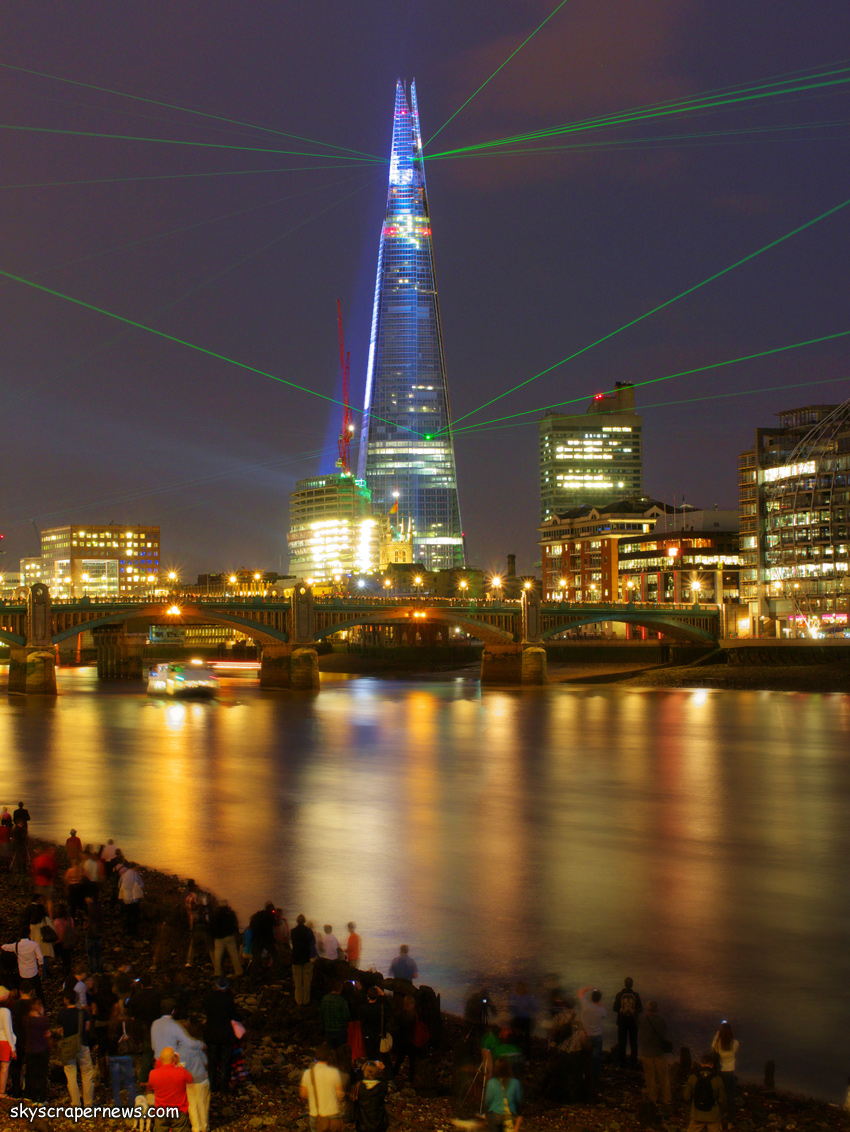
The 'Shard': looking to an urban and technological future
With the new orderliness of personal space and rigidness of professional time, one wishes they had time to write - to be more accurate, think and then write.
As an advocate of the thriving blogosphere, it is with a sort of melancholy that I look at blogs which haven't been updated at all recently. It reminds me of photos depicting the lost world of post-mining, post-industrial rust-belt regions in the U.S. Excited by opportunity and technology, a place (whether that be tangible or not) is infused with soul, and then it is abandoned.
Old and new memories, old and new objects, old and new experiences - these are indeed eternal struggles.
From Plato's Allegory of the Cave to more contemporary imageries of brightness and dimness, light has played an important role in which we understand ourselves and our environment. As post-Englightenment beings, we see it as far too simplistic to imagine how knowledge is supposed to represent light, and ignorance darkness.
But is it so uninteresting to live in the 'darkness'? Of course, many in the Middle East would profess that living in the darkness of repression and corruption is no way to live. But let us consider highly developed, democratic states, where peoples choose to live in darkness in one way or another, for one reason or another. For those who fear they are to be blinded by the lightness of outside, they take comfort in their insular and familiar surroundings. They are content in their lot, never wondering what it is like to live in other parts of the world, or even how the people in the next village live. If they were to denounce something, they would not bother to challenge its legitimacy on its strongest grounds, but on its weakest grounds. It is all too easily to criticize religion, for example, on one of their more outrageous grounds.
It is also evident that for some people, the light is too painful in its all-consuming brightness. The harsh light of reality shows the world in its true essence - both fascinating and terrifying. Perhaps this is one mechanism to cope with loss or tragedy, you try and block out what is all too crystal clear under the light. For the rehabilitating drug-user opening their eyes to the squalor and terror around them to political philosophers reading ever more deeply into theories which continue to discuss imperfect visions of the perfect society, this does not necessarily make you happier, but makes the world seem less comprehensible in its different varieties and complexities. If you find yourself in a country, you discover your continent, other continents, the world is not an oyster - but a incomprehensible sphere which you cannot even start to understand. One ray of light might enthuse your curiosity but a brilliant sunshine? It is often from the midsts of darkness, that people grow to be the people they are.
This is worth remembering, both on an individual level, and also on a broader socio-political one.
Francis Bacon is one of the most acclaimed British artists of the 20th century, and continues to drive debate and drop jaws to the floor in awe. Similar to art, politics strives to reinvent itself - reconceptualising modes of thought which were previously taken for granted.
It is with this in mind that I found a critique of Francis Bacon that further reflected political 'self's' in the Middle East. As with Bacon's work, it is the violence as the subject-matter which has been most often studied - it is the horrifying communication of an isolated individual; the pain in the paintings reflects back to Bacon himself.
This can be said about images of political violence and social upheaval today, it is a reflection of that country's problems and clearly there is some explanation for why this has happened.
But momentum in this political day and age is an underestimated quality, and this is also illustrated in a reinterpretation of Bacon's work. It is important to note the instinctive and emotional reaction the viewer feels when seeing his work - the pain of the viewer is key as it is his work's moving quality which captures the sense of our self.
As an art, a performance, an event - the political theatre in recent weeks in Tunisia and Egypt reflect this second interpretation. Having been inspired by images of political change elsewhere, they identified themselves in the scenes they saw on the televised medium - the faces on the screen are not others' but theirs. It is this moving quality of political theatre which has created the momentum that few world commentators could have envisaged at the start of the year.
Although the video games industry is just as big as the film industry worldwide, it is often seen as something of a mystery to the older generations. But it seems the conversation has moved on to such an extent that it is not remotely silly to consider video games as a form of art.
This is perhaps why I watched "9" with some interest and looked at its similarity with "Little Big Planet" - the fun interactive game I have played on occasion. The absurdity of cotton figures with a soul - surely this is the realm of video game fantasy? There is no conclusive evidence as to if there was indeed any influence from art to video game, or vice-versa - but it does give us a starting point into discussing video game as art.
Even with my limited knowledge, it is evident that computer games have come a long way. From my earliest memories of Super Mario, the target market for games has steadily evolved to include older players in their 20s and 30s, changing the nature of games - a game like Grand Theft Auto would have been unimaginable in the Zelda-dominated world perhaps 10-15 years ago. The older computer game player has also led to different demands in the video game, with narrative especially being an important part of a game.
With "cut-scenes", the Metal Gear Solid series has developed a powerful back-story which engages the player into the character and conflicts within the protagonist. Furthermore, history and fantasy commonly combine in different ways in reinterpreting how we bring stories to life.
Top Gear track on Gran Turismo - video games are becoming increasingly life-like.
Thus it is with excitement that I am excitedly anticipating reading a friend's study of interactivity and narrative in video games. But it is evident that the artistic study of video games is only just emerging and will be increasingly prominent in the decades to come.
For most laymen, the answer is probably a resounding no. But for those (un)fortunate enough to be at law school, the reply might be a little different. With the legal labour market on both sides of the Atlantic at derisory levels, some students might need a bit of inspiration in contemplating other careers.
The following studied law to various levels - the worst perhaps being the legendary filmmaker, Federico Fellini, who apparently enrolled into law school to please his parents but never actually went to any classes.
Sergei Diaghilev
Johann Wolfgang von Goethe
Honore de Balzac
Leo Tolstoy
E.T.A. Hoffman
Henri Matisse
Wassily Kandinsky
Gabriel Garcia Marquez
Federico Fellini
It is probably a good thing these figures did not become lawyers. The world would be a less interesting place without their contributions!
The clash of the historic legacy on society and optimism of a better economic future was highlighted previously. It demonstrated the potential avenues of tension and fusion between the forces of the nation and globalization, but let us consider the example of Malaysia and their MM2H visa programme.
Promotional video for the MM2H programme
"Malaysia My Second Home" encourages foreigners to set up their homes in Malaysia in return for the consequential economic stimulus that their stay will provide. In return for a £70,000-100,000 deposit, one can obtain a 10-year resident visa, providing one with a lifestyle that may be out of reach closer to home. With many coming from Europe and North America, spacious apartments, warm weather all-year-round, low taxes, good food, English spoken widely, lower cost of living, and domestic help are something akin to expected.
But what is surprising here is that the age of those applying for this programme are those over 50, closer to retirement age. It is not just the younger generation, but the older one too which have seemed to realize the economic potentials of a globalization. There are opportunities for a younger generation of manufacturers, of course, with relative high levels of education, a low-cost labour force, and the advantage of English being spoken. But it has been suggested that the older generation is not part of globalization as such, but a sort of curious group epitomising 'neo-colonialism'.
A sense of exotic adventure, to leave your dreary homeland and live in a previously unaffordable luxury; is this not familiar at all? Perhaps this is just the uneven consequences of a globalized economy, but it is relatively easy for the West to take advantage of the price differentials that come about when going to a poorer country. There are economic benefits for the host country of course; since these lands of potential are commonly known as 'emerging markets'.
The characters you might well find in a Poirot mystery. But where is Mesopotamia? Sounds exotic in any case!
But that familiar group of expat misfits is not so dissimilar to a century ago in Malaysia, or even around the world today. Let us visit the Shangri-La hotel in KL, Dubai, Hong Kong, Mumbai, Moscow - delete as appropriate. As the Scotch flows, there is the accountant who goes very red with his inability to hold his alcohol, the housewife with immaculate dress talking about haute couture as if people actually know what its all about, the eccentric but odd German whose laugh lingers a little too long, and of course the 30-something woman who fidgets with her long, narrow cigarettes looking distinctly out of place in older company. This is not just the characters of a Poirot thriller, but the peoples in an International Racing/Cricket/Golf/Women's Association in a generic, cosmopolitan city in a land far, far, away...
With the knowledge that this is some sort of extended holiday - they will return to their 'homeland' at some point - no real effort is made to integrate with the locals. Well, only if they happen to live in the same gated community perhaps. The sprinklers of the immaculately mown grass hiss in isolation, as noone would bother to actually play sports on it... Perhaps they are more interested in the culture? The unimaginative captions in Mandarin are not of much use of in the local aquarium.
The economic benefits are clear to see, but is this a life worth living - with servants and sun, but without emotional connection or a recognisable cultural milieu?
Yes, if this were me or you, we would do exactly the same - indulge in the exotic with a glass of 'New World' Chilean wine while looking out from the balcony at the sun and those poor souls sweating every sinew in pulling rickshaws who will become slightly richer. There is at least something to look forward to in older age!
Everyone now takes globalization for granted. It is like dust gathering in a room you don't go into that much, and suddenly you realize this room is there, instantly coughing when you enter. For those who do not travel that much, it is perhaps difficult to imagine how the tentacles of capital have reached to such far-flung places.
And in turn, identity has been deconstructed and to a certain extent reconstructed in a totally new way. Nations continue to define most of us, but increasingly the globalizing economy is changing what identity means. And although it shouldn't be considered a problem to be a 'global nomad' type, it does impact on how some perceive their purpose. The cultural politics of the regions encompassing formerly glorious empires such as the Ottoman and Austro-Hungarian ones reflect this uneasiness of a 'Golden Age' which has long past. Other revolutions in the second half of the 20th century ousting symbols of monarchy or autocratic power have also contributed to the questioning of purpose - especially in the Middle East (Turkey, Afghanistan, Iraq, Iran).
Orhan Pamuk's part-memoir, part-homage to Istanbul
The suicide of Alireza Pahlavi, the son of the former Shah in Iran, who was ousted in 1979 during the Islamic Revolution, is indicative of this sense of national mourning. Materially he was absolutely comfortable - living and studying in the U.S. - but with personal tragedies a further burden on his young life, he had terminally lost his purpose:
“It’s not a matter of luxury, it’s a matter of loss of identity, loss of connections … and all the time seeing something really unusual and strange [unfolding inside Iran]."
This is not however an apology for the repressive measures taken by these powers which left their population with no choice but to herald a new era of government and political power. It is the cultural and social mourning which accompanies such paradigmatic shifts to a nation's character, and the uncertainty surrounding the renewal of such a country. Coupled with this national renewal, the pervasive character of a globalized economy makes this pivotal period of cultural and social development especially fragile.
It does not help that the study of international relations - despite its advances - still uses the nation-state as the standard unit of study. Thus it is important to take smaller case studies to demonstrate what uncertainty can be created in such renewal. In the next post, I will concentrate on Malaysia, its post-colonial development and the impact of its visa system.
The designs of Dries Van Noten: "Being considered and labeled a “Belgian” designer is an integral part of my story. It is something I wear with pride, lightly, and is in no way a burden. It is always more pleasant however when it is used to describe rather than “box in”. Maybe we have finally got “what we were wishing for…” Fashion is now a global phenomenon rather than simply a “national one”. The globalization of images and aspirations has gone a long way to making this the case."
'Going global' has impacted on all aspects of life, and for the most part has been accepted in all its bewildering and exciting beauty. It is just the dregs of the past which persistently remain that continue to haunt those with any reminders of history around them.
Having previously come across Orientalism in politics and literature, it is with surprise that I flicked through an '...isms' book on fashion. Edward Said's paradigm has been used in all sorts of academic fields, and I have been particularly interested in applying it to the social/cultural politics of modern Turkey, and diasporic literature in Germany. The common theme throughout was the almost omnipresent, pervasive nature of power that extended through language and other symbols, which were ingrained into Western historical discourse.
But although Orientalism in the realm of fashion has the potential to be as prejudiced and misplaced as Chinoiserie was, its positive influence on style and aesthetics deserves attention. And furthermore, Orientalism as a cultural trend came to the fore at one of the most important and intricate periods of modern European history - at the turn of the 20th century. The nation-state project which would lead so disastrously to the First World War, was accompanied by a Communist revolution in Tsarist Russia and the final collapse of the Ottoman Empire. The modernist movement that followed the Great War came to epitomise the exciting yet vulnerable times that epitomised the whole of Europe in flux, politically (as documented extensively), but also socially and culturally. The commercialist instinct of the industrialised nouveu riche further complicated existing aesthetics and regional ideas of beauty - style marketing had arrived.
Paul Poiret's 'Sorbet' evening dress, 1912
The short-lived Orientalist trend that came and went in under two decades still has resonance today, with Paul Poiret and Serge Diaghilev being key proponents of it. While political history and ideology seeks to forget this short period in favour of a longer master narrative of the 20th century, it is a relief that remnants of the cultural history of this period survive to this day, and continue to be reinvented and reinterpreted. Powell and Pressburgers' classic, "The Red Shoes" was based on the wonderful colour and vigour of Diaghilev's Ballet Russes ballet productions; while Paul Poiret is commonly recognised as one of the most influential designers in the 20th century. Art is often submerged into history but can offer solice and meaning to one's life journey, as epitomised by this classic dialogue in "The Red Shoes":
- "Why do you want to dance?"
- "Why do you want to live?"
Having visited the Haunch of Venison gallery, I was taken aback by the tension and credibility of the thriller story told in Provost's "Stardust". I then watched the disappointing "My Blueberry Nights", which did not have half as much mystery or suspense as one would expect from Wong Kar Wai. Films ultimately must toe the fine line between reality and fantasy, where one relates to and is curious about the scene in front of us.
The 'cinematographic and narrative codes of Hollywood' which Provost uses to film footage from everyday life in Las Vegas and turn it into a story is impressive in questioning our pre-existing ideas about what we derive from cinema - escapism, voyeuristic insight into the lives of others, another meaning to one's life story, or merely a different perspective of the reality surrounding us. By including the likes of Jack Nicholson and Dennis Hopper, we question if it is the man himself or a film character we see in front of our eyes. Biopics are especially interesting because it is hard to imagine anything revolutionary being explored in them - take Mohammed Ali or Serge Gainsbourg, for example. Their narrative(s) have been told numerous times in various guises already.
A screenshot from Provost's "Abstract Action"
Provost's "Abstract Action" also warrants attention in its partially pixellated approach to show the distorted fragments of a gun battle. It reminded me of how realistic shoot-em-up video games have begun in becoming cinematic experiences themselves, while the pixels distorting the picture visually expressed the anger, power and chaotic destruction that guns are capable of. While epic gun battles between police and villains have long been experienced in cinema, it is the almost nonchalant way that these violent scenes are consumed by the younger generation - almost immune to the reality of the film/video game, it further scrutinises our perceptions of reality. Just like Facebook and 2nd Life has created the concept of an 'online' identity, digital technology in this way shows how easy it is to become detached from the tangible things which bore us due to their standardisation, mundaneness, and 'traditional' reality. Why go all the way to Vietnam to use shotguns and the like when one can safely do that in front of a HD screen in the comfort of your own home?