Tuesday, 30 November 2010

Riding the Wikileaks Wave

The recent developments surrounding Wikileaks has put Julian Assange back in the spotlight. The 'computer hacker' with a 'peculiar' sort of intelligence can now be seen as the figurehead of the Wikileaks project, with more hard-hitting leaks to be exposed in the near future.

As is to be expected, typically libertarian-angled, user-generated news websites have caught onto this fervour of excitement. And one of the more interesting links was to Assange's supposed, old blog. It is fascinating reading and gives us an insight into the development of a figure willing to take on the most powerful institutions in the world.

Here is a link to Assange's IQ.org.

His personal take on rights is particularly interesting, and is indicative of his view that technology, as opposed to the rule of law, is the defence he primarily relies on: 

Sun 18 Jun 2006 : What are rights anyway?

"Rights are freedoms of action that are known to be enforceable. Consequently there are no rights without beliefs about the future effects of behaviour. Unenforceable general rights exist only insofar as they are argumentation that may one day yield enforcement.
Hence the Divine Right of Kings, the right of way, mining rights, conjugal rights, property rights, and copyright.
The decision as to what should be enforced and what may be ignored is political. This does not mean that rights are unimportant, but rather, that politics (the societal control of freedom) is so important as to subsume rights.
Politics emerges as the expression of the battle between our collective desires and strengths. Due to the common nature of mankind, there is great commonality in some of our strongest desires. When these desires do not compete they drive politics forward to ensure their fulfillment. This is what we usually mean by the capitalised Right, a powerword, a threat of collective enforcement." 

See relevant links:
Forbes.com: Interview with Julian Assange
Huffington Post: The Secret Diary of Julian Assange

Sunday, 28 November 2010

'Cause thats just the way it is

Wanted to live a 'normal' life away from monarchy: Edward VIII and his wife, Wallis Simpson.
There are many questions which prompt the answer in this title, but none more so than the historical reasons behind the existence of the monarchy in Britain. A fellow blogger has questioned the need for monarchy, and its relevance to our modern society today. I suppose its the nostalgia for 'Great' Britain, for tradition, for legacy, for quintessential Englishness.

While several Commonwealth countries in recent years have complained about the persistent presence of the Queen in matters of formality, many Americans are fascinated by the idea of monarchy. Is it because Americans yearn for some kind of divine historicity that the artificiality of their democracy cannot replicate? Isn't this what attracts the hoards of tourists to Buckingham Palace every year - the monarchy's empirical claim to power and symbolism of a nation?
What is the point of this man aside from heading a few trusts and foundations?
But as few care to recognize, major public events concerning the Royal Family is a delicate and precise PR exercise. Noone remembers the constitutional crisis when Edward VIII abdicated from the throne, nor does anyone want to acknowledge the fragility of the monarchy after the death of the 'People's Princess' in 1997 - how could the Royal Family be perceived to be compassionate and humane to a woman divorced from the monarchy but with a strong affinity to the public?

So as people celebrate the national holiday of April 29th next year, the thought will come to some about the bizarre and unusual circumstances which have made the survival of the monarchy possible in an age where republican government defines the majority of the leading nations around the world.

The mining deaths that (nearly) spoiled the fairy tale

Refusing to be immortalised in painting: Francis Bacon's 'Three Studies of Isabel Rawsthorne' shows the sitter as a shifting, pulsating mass of raw flesh. Bacon is depicting life, only if at the same time exposing the threat to it.
The Chilean miner story gripped cafes, offices and homes around the world with a story spun to reflect the hope and resilience of mankind. It would not be overblown to say that there was a type of media 'euphoria' surrounding the event and immediate aftermath with 'live coverage' and exclusive first interviews with the survivors.

But let us consider the less extensively reported incident of the mining incident in New Zealand where 29 miners died. Was it perhaps less significant because there was four less of them? Or maybe because as a 'media story' it just didn't have any legs at all?

If the media were so moral enough to cover the story in Chile which reflected compassion and unity, why did it do so to a lesser extent in New Zealand? Everybody recognizes the need to respect privacy in times of vulnerability and sensitivity but this is somewhat skewed by the fact that the 'amazing celebration' of survival supposedly merits the need to satisfy our own curiosity about these men who are 'models of solidarity' through continuous news stories, while the families affected in New Zealand have not faced the same incursion into their private lives. They certainly have not stood looking mesmerized in the middle of an 80,000 crowd at the Bernabeu Stadium in Madrid, thousands of miles away from home.

Mortality is something journalism does not deal with all too well; nor does it want to depict the inner life of tormented, wounded man - as Bacon so poignantly does. As with any narrative being consumed by mass society, the story has to be simplified and easy to understand; the initial despair can be forgotten by the dominating euphoria that follows an incident such as this.

Speaking of the masses, let us have one final thought for the many unreported, anonymous deaths related to heavy industry incidents. For example, do we know any of the names of those who died during the BP oil disaster? More significantly, China's infamously dangerous coalmines are getting 'safer' with just over 3,000 deaths a year compared to a peak of close to 7,000 in 2002 - what does this say about the perception of the Chinese individual. Perhaps they are just a few of many sunflower seeds which are all seemingly identical.

See relevant links:
Bloomberg: NZ mining incident and the industry in general
The Economist: China's dangerous mines
Chile miners: Rescued foreman Luis Urzúa's first interview
A fellow blogger's take on the Chilean mine story
Wikipedia entry: Francis Bacon

Saturday, 20 November 2010

Watch out: China might become the next Japan

Political activism in the arts can prevent China becoming a 'Japanese' materialist society
Ai Weiwei: wants China to follow its own destiny - not a globalized/Japanese path.

Ai Weiwei has made a big splash in both artistic and political circles in the UK recently, following his Sunflower Seed exhibition at the Tate Modern. His significance has been further accentuated by the British government's 'trade mission' to China, where the issue of human rights was believed to have been raised. There is no doubt that the British are lagging behind in terms of trade partnerships with China - Germany for one has become a valuable partner for the Chinese both in terms of investment, exports, innovation and knowledge. But this masks the political and human concerns which have been expressed by many in the British media and also by  the likes of Ai and the Swedish Academy.

Liu Xiabo - Nobel Peace Prize Winner: probably does not know that the UK trades more with the Republic of Ireland than all of the BRIC countries put together.
 China's relations with the outside world is predominantly looked at from a political economy point of view, and the effect of modernisation on China's society, and in essence its psyche, has been frequently overlooked. The debate has been particularly skewed by the US v China contest which leaves the intellectuals in the humanities - especially in Europe - grasping at straws. Aside from currency rates, trade deficits and globalised capital, one must look further into where China is heading socially.

The Sunflower Seeds exhibition has an overtly political message.
This is where artists such as Ai Weiwei become significant in his standing as a social critic for China. It has been argued that the next stage for China's economic development is domestic consumption - but what will that mean for Chinese society - we are not talking about Porsche's sales revenue being propped up in China despite disappointing sales in the rest of the world.

For neighbouring Japan, Ai Weiwei's political message seems explicit, harsh, rude and somewhat anachronistic. But despite the differences in their recent histories, it is evident that China will follow Japan's footsteps towards a materialistic, consumerist society. A shallow one where Deng Xiaoping's words will ring true: 'to become rich is glorious'.

The Tiananmen Square 'Incident' in 1989 is now just a small blip with regards to the overarching upwards curve of China's progress to a world superpower. It seems nothing has been learnt about their cries of Science and Democracy - however excessively 'Westernized' those views were. These values matter now because Ai and Liu Xiabo recognise that the Chinese population are sliding into becoming a mass of 'docile bodies' - entranced by a materialist lifestyle; unable to escape the shallow life which accompanies the hoarding/ownership of things.

This is why I have some reservation about the works of the celebrated Japanese artist, Takashi Murakami. There is some validity in his reaction against the traditional styles of Japanese art which are still celebrated by the West - the Kuniyoshis and Hokusais of this world; but he is embracing the strange and wonderful that is the product of Japan's docile-ness. The otaku culture which he explores is a cultural phenomenon unique to Japan, but despite its sense of playfulness, it illustrates the shallow, closed nature of Japanese society.

Now that's what I call juxtaposition: Japanese pop art inside the symbol of the French establishment
Murakami's current exhibition in the Versailles Palace, France, is certainly provocative - the conservative strand of the French artistic establishment are certainly not happy - but perhaps this reflects the French perception of Japanese culture as embodying an esoteric civility. Furthermore, Murakami's close links with fashion and the marketing of his 'brand' is one which reflects the modern world, rather than commentating on it.
Consumerism is fast becoming king for the affluent Chinese. Is this a sign of an emerging society which is ultimately shallow and vacuous?
Of course the political instability in the China of today can be contrasted with that of the Japan's relatively peaceful, post-WWII rise shepherded by the US, but the political and social commentary of many Chinese avant-garde artists should not be lost. Progress and prosperity in the material sense should be no excuse for activism and critique to be wholly replaced by reflection and humour.

If China wants to develop its national identity distinct from the current Japanese one, it must recognise the value of its rich cultural heritage and encourage its arts to evolve freely. Germany has the Goethe Institute but also has the modern dynamism of cities such as Berlin. China has the Confucius Institute but no shining beacon of modern art  which is celebrated by the wider population - just the 'commercialised' 798 art district in Beijing and Monganshan Road in Shanghai. It is clear that the recent astronomical sales of Qi Baishi's works do not bode well for the future development of modern Chinese art.* Thus Ai Weiwei and others like him feel a sense of responsibility to preserve and develop the Chinese psyche by engaging with the population at a higher philosophical level. This needs to be further encouraged.
The one-dimensional economic perspective of China in the West is too pervasive and not exactly helpful.
We should look beyond the stark economic figures when assessing a nation's progress. Even India - another one of the BRICS - is embracing modern art (as seen at the Saatchi Gallery earlier this year). Most of the exhibiting artists did have a socio-political message - which sometimes too explicit - showed a concern for the effects of rapid economic development in other human spheres.

The art world, let alone the world in general, does not need a Chinese version of Murakami in the future. Not only would this reflect the glory of the global market in all its manifestations, but it would be rather uninteresting too.

* Qi Baishi was third last year in terms of worldwide sales behind Warhol and Picasso.

See relevant links:
BBC: Cult of Less
Takashi Murakami at the Palace of Versailles
Saatchi Gallery: The Empire Strikes Back - Indian Art Today
798 Art District in Beijing
BBC iPlayer (for UK only): Imagine - documentary on Ai Weiwei
Telegraph: Obscure Chinese painter Qi Baishi is third top earning artist

Tuesday, 16 November 2010

'It's so Brechtian' - whatever that means...!


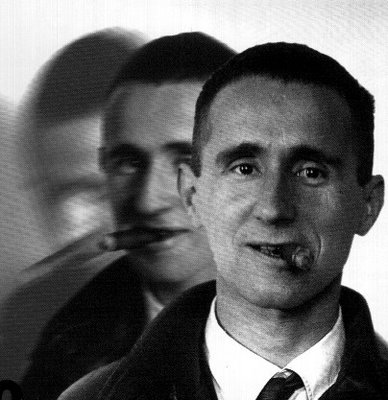
Bertolt Brecht is a name renown in German literary circles to this day in his stark criticism of contemporary society and the capitalist economic model. He was a lifelong committed Communist, but this should not mask his contribution to theatre.

His play, 'The Good Man of Sichuan', sticks in my head as a wondrous morality tale which combines the Western ideas of morality and goodness with an Oriental visual flair. As with Sichuan opera, the techniques of imitation and shifting masks provide the perfect background for the protagonists struggling to find integrity in a life beset by deceit and poverty.

The starkness of Brecht's epic theatre is also reflected in his 'Mother Courage and her Children'. The mercenary nature of the capital driving warfare is a central theme here, where the drive for revenue continues unabated for Mother Courage despite the death of her sons. Brecht's plays would not be his without a hint of political anger, but his famed Verfremdungseffekt deserves greater recognition in our era which is very much emotionally driven by others. Brecht brings out the rationalist in us, regardless of our political affinities.

Perhaps it would be no bad thing to be more 'Brechtian' in our day and age, even if that means nothing more than to know more about and read a bit of Brecht's impressive works.

Next up: Orwell

Warning: this will be biased since I have only read J.M. Coetzee's 'Diary of a Bad Year' while I have read most of Orhan Pamuk's English-language titles.

The Essayist is a strange phenomenon in this day and age where the columnist and the social commentator appearing on our TV/computer screens dominate the scene for 'expert' opinion. Even the Blogger can have some sort of influence in an increasingly crowded market of visible opinions.

But in the form of J.M. Coetzee's 'Diary of a Bad Year' and Orhan Pamuk's 'Other Colors', we have two collections of essays of the highest order. Although their styles are vastly different, the commentaries on daily life, both trivial and sombre issues, and higher philosophical machinations combine in a way that we cannot not be influenced by their words.

In the red corner: arguably Turkey's finest writer, Orhan Pamuk 
Let us take Orhan Pamuk's 'Other Colors'. His is an honest voice, observational but undoubtedly a masculine one. Having come from a comfortable background, he seems to be confident in his sentimality and integrity; an unabashed social commentator who has (inadvertantly) found his own Western-facing political tone. Occasionally he will veer into the vulgar masking a deliberate playfulness, but his essays are solely his own. Writing about his daughter Ruya, this is a man who is comfortable with family life and more generally, with the wider pubic in essence.

In the blue corner: J.M. Coetzee - an authentic voice spanning the British colonial diaspora
J.M. Coetzee's publication undoubtedly has a very different format with his short essays accompanied by a story running on the bottom half of the page with two narrative voices, one being a writer closely resembling himself, and another being Anya, a young woman who becomes his typist. His political landscape centres on South Africa, the US and Australia but what is more distinctive is his apologetic, almost guilt-ful tone. Perhaps coming from the shame that manifests itself from a voice inflicted by post-colonial/apartheid white-man's retrospection, this reflects Coetzee's public persona as a reclusive professor type with 'monkish' self-discipline. By having a separate story which comments on his opinions written on the top half of the page, the writer - which is Coetzee in his different guises - is so apprehensive and unsure of his opinions that doubt creeps into the reader about what would ordinarily be 'high-minded' opinions. There is a deliberate self-consciousness about the writer which transposes onto the reader, which suggests this is still the genre of fiction - just.

I hope publishers continue to publish essays like these, because the essay format threatens to be the most truthful and revealing way of showing one or more sides to one's public persona. As they are both Nobel winners, it is obvious that their essays command some respect; but writing fiction with imagination and writing essays with insight are two very different things.

Next on my list are the essays of George Orwell. How will his voice compare to the two mentioned here?

Sunday, 7 November 2010

Pirates - still a pain in the legal backside

Pirates have been around for donkey years (as long as Peter Pan at least) but the law still hasn't really caught up with them.
Ah, those Somalian devils. With an AK47 slung across their back, they count the cash which probably came via DHL from London. Lloyds' of London - ever since its inception in a small coffeehouse in around 1688 - has led the insurance sector into securing against pretty much anything - vocal chords, hair, space flights and of course pirates. But why has international law lagged behind in attempting to punish these outlaws in the Gulf of Aden?

This BBC article shows how difficult it has been to get international consensus on how to convict captured pirates. Which laws? Which jurisdictions? Which due processes? Without money, time and most importantly political will, the steps towards a trial and conviction will continue to be painfully slow.

Of course there must be impartiality before the law but the pirates have got major international powers into a political quandary. With the US, EU, China, Russia - among others - having a vested interest into the safe passage of cargo ships in the area and the criminal convictions of those thwarting this business, it will only be at the political level that any legal processes can actually work.
Lloyds' of London: where pirates get most of their hard-earned ransom money from.
It was also revealed by the BBC a few months ago, that the British government is actually blocking a sanction at the UN to take action against two suspected pirate organisers. This is nothing to do with human rights; this purely hinges on a legal technicality - in the UK, paying a ransom is not a criminal offence. Coming back to the famous Lloyds' insurance, I wonder how much they are responsible for this particular legal development - since most ransom negotiations with the pirates currently go through London?

But this opens up a wider question on jurisprudence in the developed world. International law is comprehensive enough but by no means anywhere near pervasive or complete, and frequently relies on political nous to work at a practical level. Furthermore, when the laws of the developed West clashes with those in the less developed world - where talk of legal culture is much more widespread than law in its strictest sense - it can cause widespread problems. Observers of the wealthy Gulf states would know that 'petro-dollars' have a considerable influence as to how law in these countries is being developed. Borrowing bits of English and New York Law, commercial transactions laid forth by legal whizzkids have to skilfully skirt around the traditional condemnation of debt and interest in Islamic law and finance.

Whereas the West likes to think that it works by democratic consensus, institutionalised safeguards and with due process, it is struggling to understand how developing countries with astronomical growth rates could laugh at this rule-of-law 'drivel'. The Chinese especially have quite a different view on what the law means. Their Legalist school of thought is particularly revealing - which advocates for a common focus on strengthening the political power of the ruler, of which law is only one part. You won't see (m)any Chinese quoting from their Constitution which advocates freedom of speech or religion!
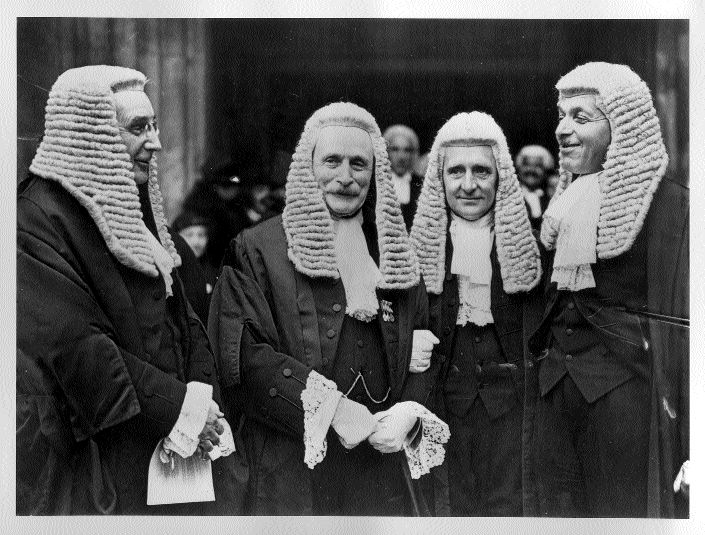
It's not only wigs that makes the law as we know it look a bit ridiculous sometimes.
The West has long prided itself on its economic power and legal integrity, but for all its development in the philosophies of law, society and politics, those pirates are still finding enough loopholes for a few people in the political/legal elite to look a bit silly.

Incidentally, I wonder what pirates think of the law? I'm not sure but they might be smiling like this:


See relevant links:
Wikipedia entry on the Chinese philosophy of Legalism

Friday, 5 November 2010

Too lefty for my Liberalism

The political spectrum 'circle'
As history has taught us, the extremities of the left and right wing are not actually too far apart. The pendulum had swung quite nicely to the left in Atlantic politics until a few years ago. New Labour governing for over a decade in the UK, and Obama becoming Europe's favourite US president for absolutely ages.

But in these austere times, the liberals are questioning what went wrong. The web is littered with articles trying to put some perspective into the success of the Tea Party movement, and questioning the legitimacy and integrity of the left wing in the developed world. And furthermore, you have China and Brazil championing national champions in their meteoric economic rise - just to rub salt into Western wounds.

My last words today are 'borrowed' from the Maverick Philosopher's excellent blog entry. It is uncomfortable to stand unflinchingly for convictions that I accept as only relatively valid; one must utilise conviction and flexibility reflexively to aim towards moral and political maturity.

Here is a selection for you to enjoy, if you don't know much about it already:
The increasingly complex politics of Climate Change
Happy Meals being banned in San Francisco
YouTube: How Liberals Argue
Maverick Philosopher blog - Conservative Activism, The Left's Incomprehension, and the Genetic Fallacy (2010 Version)
Stumbling and Mumbling blog - Dobbs Paradox

Language in its modern guise - Pacific Asia focus

"Do you want a burger? Do you want some beef?!"

'Beef' means 'to have a fight'
Further to my last post on language, it is also revealing to see how slang, colloquialisms and text-speak have influenced our perception of language. It is not just management speak like "ideas showers" (because obviously its so un-PC these days to say brainstorm...), "going forward" and "in the pipeline; the transformational role of technology must also be considered in the evolution of language.

As is popular in most parts of Pacific Asia, SMS's are littered with :-), :-s, (^_^), (*_*) and other quite amusing symbols. Whether this has got anything to do with the historically pictographic nature of the Chinese or Japanese languages remain to be seen.

Furthermore, the following web page shows how Chinese bloggers and net-izens get around China's notoriously stubborn internet firewall. While the government there employs "5 Yuan warriors" (an army of computer geeks to censor unsuitable online materials for $0.75/£0.50 per site), the younger contingent of China's 1.3 billion population are finding ingenious ways to get around the system and talk about things most Western youngsters freely do.

For example, while we say 'po-po' for the police, the youth in Greater China rely on the introduction of 'pinyin' in the Mandarin language: 警察 = jǐngchá = JC. Pretty clever, right? ;-)

Writing authority: the diverging rules of law and language

 
Contrasting the rules of language which govern legal certainty and post-structuralism

As any law student will know, understanding language in all its precise and pedantic forms is an essential skill for their career path. When one has to advise a client, it is important to understand the probabilities of how legal procedures play out and what is the best course of action to take. Thus the interpretation of language is key to convicting someone or getting multi-million dollar damages.

I am no linguist (in the scientific sense of the word) but it strikes me as peculiar how the law student will try and ascertain the legal certainty of language, while others in the humanities are busy breaking it down to find new meanings in texts. Although it is difficult to believe fully in the 'death of the author', it is evident that text is removed from its author to a certain extent. Especially when it comes to the advertising billboards that we see every day, this is their purpose - to remove themselves from the author and delve piercingly into the observer's mind.

Furthermore, the study of literature is enriched by multiple, overlapping meanings. There are no restrictive rules like in the study of law where one learns the three key rules of language (literal/golden/mischief rule); there is no real purpose to a strict understanding of the text in literature, whether it be in a personal or commercial setting. It is enriching - not distracting - to have many interpretations of the same words. The reader of the novel is worried about the relationship between him and the words in front of him; one wants to get swept away in an entrancing discourse far removed from the hard-nosed considerations of certainty and risk-management.

But the key difference between the development of legal and literary language is this. While authority in a legal document is ascertained by its link to the force of the law and the State, authority in literature is at its strongest when the author is unaware of it. Writers have no natural wisdom but their words have most authority when they themselves are not conscious of the power of their writing.