Wednesday, 27 October 2010

Technology and Human Nature - Only One Key Difference

Are you a hawk...
Technology and Human Nature agree on two common things which drive them on: sex and food. But curiously, it seems the third key ingredient is somewhat different: for technology it is warfare; for human nature it is sleep. How odd...

... or a dove?
Peter Nowak's book 'Sex, Bombs and Burgers' details how 'war, p*rn and fast food created technology as we know it'. While William Saletan on his Slate.com 'human nature' blog says initially that sleep must be the most important out of the three. Technology and human nature - how they must co-exist!

See relevant links:
Festival of Ideas: Peter Nowak
William Saletan's blog on Slate.com

The Rise of the Pre-nup, Partnership and Platonic

The Frenchman and German heiress who fundamentally altered English divorce law
The Granatinio/Radmacher divorce case is being called a landmark case, as it suggests that pre-nuptial agreements is now a legal document that can be used legitimately in English courts. The particulars of the case - a French ex-banker/Oxford don who had married a beautiful German heiress - certainly had many divorce lawyers observing with great interest. Because evidently London is the divorce capital of the world, right?

But apart from the legal implications of the case, it is important to consider the wider dynamics between male and female in society. From one angle it seems that England and the rest of the U.K. is heading towards the recognition of the pre-nup like in the U.S. - increasingly the romantics associated with the institution of marriage are becoming eroded, and replaced by legal ramifications, joint bank accounts and tax breaks. But it can also be argued that the pre-nup - while making the institution of marriage fairer and more equal to both parties - automatically introduces a sense of distrust to a relationship. "What do you mean you love me more than anything, but you're still afraid I will take off with all your precious assets?"

And to complicate things, whatever will happen to White v. White, which set the precedent for courts to consider first an equal, 50-50 split of assets between man and wife?

Divorce - the ultimate high-stakes poker game
The institution of marriage in modern times seems just a little troubled, given the devil-may-care attitude to it. I can always divorce. And in ideal situations, separated parties can maturely settle arrangement which makes the process of falling out of love with someone a less stressful transition. But it is unfortunate how adults quickly and easily change to behave like children over spilt milk. Hate, I feel, is a rather strong word, but it gets bandied around quite a lot in the fiery, high-stakes poker game that is a divorce case.
"I now pronounce you partner and partner"
Some argue that marriage is an anachronistic institution unsuitable for our times - how about we all try the civil partnership? The legal and financial security of marriage is still there, but the civil partnership model for some reflects a more tolerant, equal society. With religion, patriarchy and other sources of tradition sweeping us by, it has been suggested that husband and wife should be replaced by partners. I have always wondered what people mean when people say, 'I live with my partner'. Is the Oxford American Dictionary correct in its definition of a 'partner' as 'either member of a married couple or of an established unmarried couple'? This is the background of those in the UK who are pushing for straight-sex civil partnerships, which are currently forbidden here.

Best fwends a.k.a BFF: The first image that came up when I google-image-searched 'platonic friendship'
And finally we must consider the rise of the Platonic friendship. For centuries before our own, a friendship between a man and woman was unheard of, or at least very much frowned upon in all cultures and societies around the world. Our biological traits showed us to be incompatible apart from our natural instinct to reproduce and extend our bloodline. In most societies in the West, Platonic friendships between a man and a woman is taken for granted. We are supposed to be very comfortable with just hanging out with the opposite sex and not have an iota of sexual attraction for them. Some people have rubbished this concept - it doesn't exist, they say. Of course, things are never as simple as they seem to be, but it is food for thought that the progress of modern society is inconsistent, incomplete and less universal than we assume.

The picturesque boarding school where Prince Charles schooled. Cold showers, early morning runs and bullying - the healthy diet which old-fashioned education establishments thrived on in the past. 
Just ask those poor ex-boarding school pupils who make up a healthy chunk of clients for shrinks!

See relevant links:
Financial Times - UK court upholds pre-nuptial deal for heiress
BBC - Why would a straight couple want a civil partnership?
Slate.com - The story of a platonic friendship
The family law case of the decade: White v. White

Wednesday, 20 October 2010

The integrity of postmodernism - colouring shades of grey

'Structures don't protest on the streets'

The origins of poststructuralism in Paris in 1968 led to a revolution in intellectual thought as the established rules of language, institutions and norms came crashing down. This indeed seemed like putting the final nail in the European Enlightenment coffin; intellectual thought would never be the same again. And as they say, the rest is history.

Now it seems that postmodernism is the dominant force in our society as there can be meaning in anything and everything at the same time. Hyper-relativity of today's instant media makes it doubly difficult to find truth and essence. Imitation, repetition, globalisation - these are the forces which have dumbed our senses down but show no sign of their influence abating. We are at a loss to find that precious needle in the haystack.

Anish Kapoor's 'Tall Tree and the Eye' - filled with clear meaning?
You look at a sculpture and wonder what it possibly could be. Without a caption, you might actually be a little miffed. Is this 'good' art when the explanation seems unnecessarily convoluted? Is obtusity the name of the game - a new kind of elitism where the brash confidence of the individual as a brand is celebrated in the full glare of the media? And it is open to question whether we would all agree with J.M. Coetzee's assertion that:

'In the present "culture", few care to distinguish - indeed, few are capable to distinguish - between sincerity and the performance of sincerity.' (Coetzee, 2007)

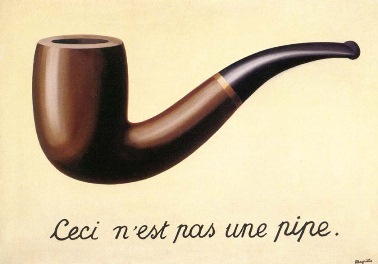
Rene Magritte's 'The Treachery of Images' - this is not a pipe, but an 'image' of a pipe
But this does not mean that the postmodern project is a futile one; we should not be writing its obituary just yet. As with any quality cultural or intellectual pursuit, the process must be rigorous and open to scrutiny. Only then can we sort out the rainbow of colours from the shades of grey.

Otherwise we might get the laughable stupidity of America we all love to laugh about in Britain: 'The rise of Idiot America today reflects - for profit, mainly, but also, and more cynically, for political advantage and in the pursuit of power - the breakdown of the consensus that the pursuit of knowledge is good. In the new media... if everyone is an expert, then nobody is... That because there are two sides to every question, they both must be right or at least not wrong.' (Pierce, 2010: 8)

Idiot America has seeped into popular culture through the music of Green Day
Of course the British would never admit to have plunged to such dire intellectual depths, but it is a possibility - especially for the docile population to embrace their own 'chav'-ocracy. Well at least we wouldn't possibly vote for someone like Christine O'Donnell, right?

Relevant links:
Guardian Review of J.M. Coetzee's Diary of a Bad Year
Google Books: Charles Pierce - Idiot America
YouTube video of Christine O'Donnell - "I did not go to Yale"

Sunday, 17 October 2010

Sunday Digest - Animated Lessons in Philosophy

The clear blue skies and sunshine betray the seasonal Gods. October is upon us and the cold wind hits you boldly in the face, waking you up from the dreamy sleep and the wine from yesterday. It's a Sunday, the day of rest - what better way to spend it than relaxing at home with the rays of sunshine filling the room with clarity and calm; with a laptop on your knees as you curl up in your favourite armchair. Then you might read a blog or watch something on Fora.tv.

You want to encounter ideas but not something that will crush your mind with depth or unnecessary complexity. You click on the link below and you are transported to an intelligent plain, thinking this is quite possibly the most engaging philosophy lecture you've ever seen.

Matthew Taylor: 21st Century Enlightenment Animated (Fora.tv)

You finish watching it, ponder, and perhaps a wide smile spreads across your face about the wonders of our world. :-)

See relevant links:
Cognitive Media UK's blog

Other good Sunday reads:
Slate Magazine including this article from Anne Applebaum
Kathryn Schulz's 'Being Wrong: Adventures in the Margin of Error'
Social by Social: A practical guide to using new technologies to deliver social impact
Benoit Mandelbrot talk at TED.com

Monday, 11 October 2010

The curious case for Imagined Communities

'As a White Nationalist you'd be a bit of a contradiction, but as an ally, a valuable partner'

'And get the hell out of Oakland ASAP. You'll have nothing but trouble there, it's as bad as Somalia these days.'

These are just two responses to a thread on the Storm Front website, an organization which advocates for 'White Pride Worldwide'. By inferring that Oakland is not a suitable area for the white race, the posters are left in somewhat of a quandary as an American boy - whose heritage is half-Japanese, half-German - professes to the ideology of white supremacy. 

 
The colour of the eyes can deceive

It is odd really, considering how residents in cosmopolitan, global cities take it for granted that nation and race do not matter that much any more. But for many, figuring out one's identity is still a complicated and messy business. Benedict Anderson's concept of Imagined Communities helps us deal with the complexities of origin and 'home' - his main premise being that a nation is 'a socially constructed community, imagined by people who perceive themselves to be part of that group'. 

Let us consider some case studies:

Being 'Turkish' in Germany - Turkish migrant workers helped to sustain West Germany's economic miracle after the war, but have struggled to wrest away the Gastarbeiter image since then. Continuing into the second generation, Germans of Turkish origin have tread a fine line between acceptance and humiliation. The mullet haircut which is so popular with the Turkish German youths of today is an explicit symbol of being stuck between two communities. This sense of transience is epitomised by the extended title of Emine Sevgi Ozdamar's 'Das Leben ist eine Karawanserei' ('Life is a Caravansary; has two doors, through one I go in, the other I go out'), an example of the growing body of diasporic writing in German literature.

Being 'Lebanese' in Mexico - Arabs had migrated to the Americas from the mid- to late- 19th century in search of economic opportunity, with some settling in Mexico. Despite these migrants coming from many parts of the Arab world, gradual acceptance and success in Mexican society gave rise to the adoption of a 'Lebanese' identity, and the construction of a Phoenician and Maronite heritage. Carlos Slim Helu - one of the richest men in the world - embodies the success of the immigrant elite class. 
*Thanks to my friend MT for the information.

Being 'Chinese' in Singapore - Chinese settlers in Malaysia from the 15th century onwards have cultivated their own culture - Peranakan - which emphasises their mixed Chinese and Malay allegiances, but this has not been the case in neighbouring Singapore. One has to take into consideration the temporal difference of Chinese migrants in Singapore as identity formation and evolution has took place to a large extent in the 20th century, but 2nd and 3rd generation Chinese Singaporeans feel more 'Chinese' than their parents. Whereas their ancestors identified much strongly with local Chinese ties - i.e. Hakka ethnicity, speaking Cantonese - the government categorization of 'Chinese' has meant many of the younger generation feel a strong allegiance to their 'Chinese' origins by learning to speak Mandarin. A similar process can arguably be taking place now in Taiwan - is Taiwan identity compatible with a more generic, imagined 'Chinese' one?
*Thanks to ZL for the information.

Being 'Japanese' in England - if anyone who has read Kazuo Ishiguro will know, it is remarkable how he is able to enter different national mentalities. The rustic British quality of 'Remains of the Day' is as authentic as the struggle to grasp the legacy of Japanese militarism in 'Artist of the Floating World'.  

Being 'Jewish' in China - Matteo Ricci is famous as being able to influence the Chinese imperial court with Western ideas of mathematics and medicine in the late 16th century, but nothing could have prepared him for the discovery of a Chinese Jewish community in Kaifeng, Henan province, in 1605. The Kaifeng Jews, removed from the rest of the Jewish diaspora, were able to preserve Jewish customs and rituals, with historical records suggesting this community had existed since at least the Northern Song dynasty (960-1127). This small group have reconnected with mainstream Jewry, and some have 'returned' to Israel recently.

Which 'imagined community' are you a member of ?

It is evident that for many of us, identity is a fluid concept that changes direction as the wind blows. Thankfully we are not confined to labels and it is quite alright to sit in those grey areas. It is not terribly comforting to be in limbo, but would you have it any different? What socially constructed community do you want to be part of? cough*facebook*cough

See relevant links:

Sunday, 10 October 2010

The legacy of Eve from the 19th century to the present

Clare Shilland's portrait of 'Merel'
The essence of the woman has been explored from time immemorial; to such an extent perhaps that it is difficult in our postmodern age to truly derive meaning about femininity and its relations with the other gender. Vulnerability, empowerment, sexuality, demonisation - these are common themes that continue to fascinate us, myself included.

Some have been quick to judge contemporary art and its alleged brash, zeitgeist-capturing polish - Tracey Emin's My Bed has come under much criticism from more classically inclined connoisseurs of art, for example. But our fascination with history does remind us of the riches of looking back into the past to create new stories. 'His-story' has been written by published peoples; this is my short attempt at a history of the female.

Judith Walkowitz's 'City of Dreadful Delight' is a useful starting point in whisking ourselves away to the Victorian Britain. The Jack the Ripper phenomenon which still breathes today represented a discourse centering on an imagined myth with overlapping representations of sexual danger. The conformity and stifling morality of London in the 19th century being challenged by social boundaries, which were regularly transgressed by illicit acts of sex and crime. That typical sense of British prudishness is challenged further by the paintings of William Etty, who is rather unfashionable these days in his depiction of sexual frankness, desire and shame. It is evidence, Howard Jacobson argues, of the Victorians being 'true masters of the erotic'.

William Etty's 'Candaules, King of Lydia, Shews His Wife by Stealth to Gyges', 1847
Although this painting references ancient Greece, Etty is seen to embody 'the moraliser who will tremble to greater artistic effect than the hedonist'. Furthermore, it raises the idea of the man's vulnerabilities in the face of the female image that they themselves were instrumental in creating:

'But what fires the idealisation, however crazed, is a longing to be in love, and behind the longing to be in love is a longing to lose one's head. And only the morally responsible with their troubled consciences, can measure the depths of pleasure waiting in the act of losing all sense of responsibility at last.' (Jacobson, 2010)

Another challenge to the form of the 'eternal feminine' comes from Paul Gauguin, in his rejection of conventional representations of the perfect, symbolic female, in his explicit introduction of awkward or grotesque elements in his painting. Beauty is wilfully distorted from its Western principles, although it would be wrong to say that paintings such as 'Words of the Devil' are merely esoteric narratives of Orientalism; Gauguin's icons of female identity are not just a simple rejection of 'Marianne'.

Paul Gauguin's Parau na te Varua ino ('Words of the Devil'), 1892
Let us transport ourselves fifty years or so to the intellectual hub of Vienna. Sigmund Freud has hit the intellectual scene with his novel ideas on human behaviour; he bases some of his research listening to the thoughts of Viennese society women - their vices, secrets, and illicit desires. The Oedipus complex shocks polite society but gradually becomes part of mainstream psychological studies. But it is rather odd that we say Freudian slip rather than Jungian slip - why did Carl Gustav Jung achieve less prominence, and why do we carry Freud's ideas so lightly on our skin?

Carolyn Steedman's 'Landscape for a Good Woman' , 1987
Carolyn Steedman's 'Landscape for a Good Woman' is an implicit rejection of these ideas, in her (auto)biographical account of her emotional relationship with her own mother in a cocktail mixing historical scholarship and personal family discovery. She railed against the litany of mother-daughter 'romantic' histories, arguing that established models of family relationships marginalise individual narratives in history; not everyone can identify with the weird and wonderful ideas of Viennese ladies. Nor can family relationships be categorised by class as Marxist academics had tried to do. 


I had the privilege of meeting Ms. Steedman, and told her I was enjoying reading her book. She replied, 'Oh that's very good, but I have written other books since then you know.' But right now, her book provides a fitting conclusion to my brief history of femininity. 

See relevant links:
Howard Jacobson's 'Flesh' on Channel 4 - broadcasting soon

Friday, 1 October 2010

It runs in the family... just don't tell the Chinese!

It's always fascinating meeting the siblings of your friends. They have nicknames for each other, they're brutally honest about everything, and somehow it's a bit odd because facially, faint similarities can be identified - is it alright to think a male friend's sister is hot stuff? But in the developed world, we will see far less of these familial idiosyncrasies than the age of those perky baby-boomers, as families only number 2 . x these days.

Audi A2: probably has a smaller carbon footprint than the average person in the developed world. (I don't know if this is actually true...!)
I was once contemplating out loud about getting a new car. 'That's just ridiculous, your family has two cars already'. What a rude awakening that was from day-dreaming about a 5-seater Audi A2. 'Carbon footprint, hmm...'. She made me feel a little guilty. And then one thing leads to another, and you start to think whether the Chinese with their one-child policy got it right after all. China is surely the bastion for sustainable living. 

But surely for our decadent, consumerist generation, life would be less colourful. No more calling your sister 'chubba', nor mercilessly poking the fat around the stomach. There wouldn't be that sense of comparison either. How could you have turned out even with a slight change in your environment; how would your genes have developed then? One could be a political protege, but defeated by his younger brother for Labour Party leader candidacy. While you may have competency in one language, your elder sibling might be racing away to study weird and wonderful alphabets like the Cyrillic one. A sister might be a party animal downing vodka while the brother looks after pray mantises or something random like that. And of course, your construction of identity might be totally different. 

'Love thy brother?' Ed 1 David 0 - the elder brother maybe has more notches on his bedpost though?!
It is really quite strange. You turn left at the family dinner table and think how different is this person? How much will I see them when I start my own family? But in an abnormal kind of way, that ever-so-familiar face completes you and becomes an integral part of your being - whether you like it or not!

Hijacking the sympathy of death

It's not exactly great to go into such a morose subject as death. I wonder what thanatologists (academics who study death and dying) are actually like - probably not dissimilar to me and you, in civilian clothes and the whole shebang. But despite this momentary diversion, it is clear that talk of death is not particularly 'kosher'. If we are to see the glass not just half full but overflowing, should one merely sideline this issue as just a little bit too taboo?

It's not easy looking death in the eye
I think it is important to think about it at least, as death in the media is recreated in such dramatic and tragic varieties; part of a grand story with Samuel Barber or Mozart's Requiem in the background. This not only shows our feelings, but also how manipulable and easily 'falsified' these emotions can be. Let's consider the following case:

You hate a person for some reason or another - he/she is too obnoxious/awkward/arrogant/bitchy/evil. Delete as appropriate. But then you hear that this person has a life-threatening illness. Oh no, as you look behind your shoulder you can see guilt, regret, perhaps a hint of embarrassment slowly creep up on you.  So far the narrative is holding up.

Would you feel sorry for her? Isn't she incredibly 'plucky and bubbly at heart'?
But it is your worst nightmare, as the curtains rise and it is revealed that this person was just a bloody good actor. So believable, fell right into the trap. Anger and confusion join in the heady mix of thoughts that flash across your brain.

In our secular world, it is the prospect of death that often brings disparate people together. It is part of common humanity - the international language of feeling. We rely on this so much as part of our meaning of life  in the absence of religion and spirituality - it is the romance of life which keeps many of us going. But of course there is a trap here as emotion can be psychologically manufactured so effectively these days. 'You show them what they want before they even know they want it'.

'Live with dignity, die with cough*questioned*cough dignity'
We come together faced with our inevitable mortality but what if the tragedy becomes a farce? What if death is not essentially important but inconvenient? The huge sighs of frustration commuters let out this evening when a person jumping in front of the train resulting in a fatality is testament to this. Whoever committed suicide was just a little bit selfish and inconsiderate. Going to be late for my meeting/dinner date/holiday!?!?

Note:
Thanks to the wonderful Perez Hilton for the 2nd picture. I don't know who he is really, but pretty funny all the same.