 |
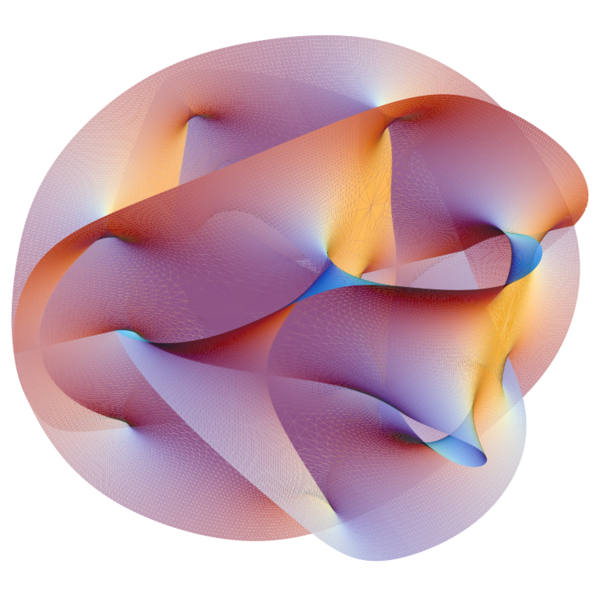
| Is this what M theory looks like? |
Dawkins of course has to dominate my treasured Comments pages of The Times, seemingly going round in circles arguing about how religious leaders misunderstand science and misframe their intellectual enquiries. Then come the likes of Ruth Gledhill and Jonathan Sacks hitting back arguing, religion is still relevant, etc. I think they all have a degree in linguistics and philosophy, especially when they come out with things like, 'what do you mean by meaning?' Seriously...
But I think there is a more subtle point to be made here. Hawkings, as an all-encompassing sort of physicist, is trying to come up with a set of 'scientific' laws which govern our reality. His theory is not readily provable in a laboratory, nor is it universally accepted among physicists, who argue that his ideas are pushing towards philosophy and ethics. Sadly this is not a cue for those weird creationist people. How I interpret this, is that with M theory - a universal set of laws which govern the world, much like fundamental religious principles - God or any higher being no longer has a role in explaining the beauty of science. For some, the beauty of science is essentially what life means.
It is perhaps a little too extreme to say that atheists do not think there is meaning in life. In our modern, secular world, people do find their own meanings of their existence - similarly some scientists are inclined to think that the beauty of science is a meaning in itself. I remember at one house party during university, a maths boff wrote this extraordinary set of squiggles and letters that made up this complex formula with a marker pen on the fridge. "That's beautiful, isn't it?" He enquired enthusiastically with a can of beer in his hand.
Of course at the time I thought, "bloody hell, what a fruitbat... why does the water-polo team attract oddballs like these?" But now I kind of get it. And I can also smily wryly at another maths boff who would explain how he ate his jam sandwiches: two slices of white bread, with jam spread evenly on one side making sure it doesn't go over the edges, cut the bread diagonally to get two triangular pieces, consider it as an isosceles triangle and eat the two corners with the same angle first, and then the other corner.
Indeed life is beautiful, I really wish I could appreciate jam sandwiches in that way...!
Trusted links from the Beeb:
Hawking: God did not create universe
Profile of Jonathan Sacks - if you have access to BBC iPlayer, you can watch his 'A Case for God'
Dawkins, Christianity's not best friend


n "The Grand Design" Stephen Hawking postulates that the M-theory may be the Holy Grail of physics...the Grand Unified Theory which Einstein had tried to formulate and later abandoned. It expands on quantum mechanics and string theories.
ReplyDeleteIn my e-book on comparative mysticism is a quote by Albert Einstein: “…most beautiful and profound emotion we can experience is the sensation of the mystical. It is the sower of all true science. To know that what is impenetrable to us really exists, manifesting itself as the highest wisdom and most radiant beauty – which our dull faculties can comprehend only in their primitive form – this knowledge, this feeling, is at the center of all religion.”
Einstein's Special Theory of Relativity is probably the best known scientific equation. I revised it to help better understand the relationship between divine Essence (Spirit), matter (mass/energy: visible/dark) and consciousness (fx raised to its greatest power). Unlike the speed of light, which is a constant, there are no exact measurements for consciousness. In this hypothetical formula, basic consciousness may be of insects, to the second power of animals and to the third power the rational mind of humans. The fourth power is suprarational consciousness of mystics, when they intuit the divine essence in perceived matter. This was a convenient analogy, but there cannot be a divine formula.