Friday, 31 December 2010

Now thats what I call Art... 2011!

Finishing the year with the art of Cezanne and an opera by Engelbert Humperdinck in my mind, there are four issues which I wish to explore further in the Arts next year. These apply more to the visual arts but cover other areas too.
An example of Cezanne's chiseled and rustic depictions of farmers in rural France.
- The 'flatness' of art: How modern media can flatten our perspective and why new technology means we see traditional artistic forms such as painting as 'lacking' life and resonance. We want 3-D, not two dimensions. And how about the fourth dimension of time, how 'flat' or linear is time in our perceptions?
- Commerciality: Why does something become so valuable? Does everything Charles Saatchi and Damien Hirst touch turn to gold? And would a painting in the Renaissance period be any different? It is creating value by giving life and society meaning - we are essentially marketing ourselves.
- Meritocracy v historicity: How to reconcile the 'elite' nature of more classical forms of art with art which is free, democratic and universal. Is there such a thing as meritocracy in art at all? Or perhaps how we assert our identity is more important than thinking of ourselves as an 'equal' cog of society.
- Patience: the impermanence of today's art contrasts with the timeless and enduring power of other arts which took time, skill and perseverance.

'Trans-media Video Artist': Nicolas Provost

See relevant links:
Nicolas Provost at the Haunch of Venison
Criterion.com - For the more sophisticated film lover

2010 - it's a wrap!

Season's greetings to all those reading, 2011 promises to be just as exciting and infuriating.

It is slightly odd being in the festive season which is largely devoid of the politics and debate that dominates most of the year. The drama and hysterics which demand so much of our attention seem to hibernate, only for the world to function at its hectic pace once again in the New Year. 

Whatever your political and professional capacity may be, all is sort of irrelevant in the milieu of family and friends. A world without the study of society, absolutely. But the world without the meaning of close relatives and confidantes, this is impossible. And perhaps this is what is most important for many at this time of year. 

Among the brashness and bitchiness of the city, shards of vulnerability expose themselves as they escape from the mirror that tries to lie, deceive, deviate, promote, or enhance. After the dreaded drunken excesses wear off, those closest to you bare their naked skin from the warm, thick fur which protects their respect, dignity, status and whatever else not as important as the basic human essence. 

I started this blog to record intriguing things about our world, and question how life is lived and represented. I would hope that this will continue, as my writing matures and perhaps become more honest.

The most realistic drama this year (of life itself) is a wrap. Let the new series of the show continue next year!

Sunday, 12 December 2010

A World without Society

The absence of signs in the purity of wildlife photography
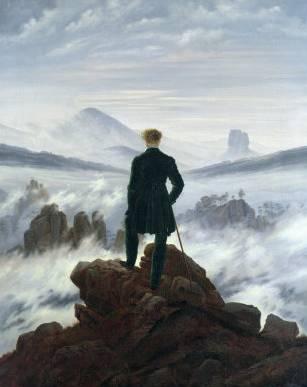
Caspar David Friedrich's "Wanderer above the Sea of Fog"
As Friedrich's Wanderer testifies, man's relationship with nature is at once terrifying and exhilarating; the mastery of the environment challenged by the realization of our insignificance in the wider scheme of things.

And that is exactly how I felt having seen the outstanding Wildlife Photographer of the Year exhibition. Lost in thought, I quietly went from photograph to photograph, inspecting each one curiously and often in awe.

An entry from this year's eventual winner, Bence Mate

Of course, one can manipulate the picture - it is your choice to position the camera where, with what light, with what exposure - but the intention of the photograph is quite different to an artwork, like painting for example. The reality behind the camera lens cannot lie, even if it can seem deceptive - sometimes dream-like or other-worldly in its equality.
Here is a collection of some I found particularly impressive:


Of course these four examples are more of an artistic nature, and does not give a complete representation of the stunning photos on display. There were many more which showed different species, different habitats, and different natural phenomena. And like art, one could appreciate these photos in various ways which reflected the wonderful ability for the camera to capture a fleeting moment of the natural world. 

Jose Luis Rodriguez's winning entry was disqualified last year.

Photography competitions is not without its politics. Last year's winning entry was disqualified after an alleged 'animal model' was used. But nonetheless, it is refreshing to step outside the realm of the human and social sciences, and perhaps consider for a moment the insignificance for our average expected 82.5 years of life when turtles and cacti can outlive us by a few decades. 


See relevant links:
Veolia Environment Wildlife Photographer of the Year


Friday, 10 December 2010

Futurism, Finance and Technology

Umberto Boccioni - "The City Rises" (1910)
We use and read the word "technology" so freely that many of us do not stop to think what it actually means. This is just one dictionary definition:

"The branch of knowledge that deals with the creation and use of technical means and their interrelation with life, society, and the environment, drawing upon such subjects as industrial arts, engineering, applied science, and pure science."

Undoubtedly the concepts mentioned in the above definition had some prominence in the work of the ill-fated futurists in the late 19th and early 20th centuries. Derided by classicists and pacifists alike, the speed and dynamism of Futurist art showed a tremendous enthusiasm for technical innovation and a resilient faith in the future. The connotations of war and violence preceded the Fascist ideology which was partially inspired by this artistic movement. 

But what can we say of technology now? Of course military technology is just as important, although it is now being reconceptualised to include information- and cyber- security. We have embraced the digital age with online identities and our everyday life is framed by mobile phones and computers. The technology we typically think of today is practical, relevant to daily life, and electronic in nature. 

For a moment, one must move away from Main Street and consider the information technology which makes capitalism and globalisation work. It is sophisticated computer programming which makes many of the things we take for granted possible - even those sushi sets to take away for lunch! And furthermore, the whole concept of finance is built on the management of risk, something which can be done more efficiently with the use of this information technology.
Robert Shiller, an acclaimed economist at Yale University
So as Robert Shiller asserts, finance is a type of technological innovation. Those derivatives and 'black holes' that laymen cannot understand are technologies which innovate the way capital is distributed in as efficient a manner as possible. This is also what those super-clever tax accountants and lawyers do in their basement offices all day long, constantly re-aligning the interests of their clients to arrange their finances.
Lyonel Feininger - "Mouth of the Rega III" (1929-30)
"Conveying a feeling of infinity and loneliness and, at the same time, of harmonious dynamism." This describes Feininger's painting above, but arguably it could equally be applicable to the power of financial technology that is essential to modern capitalism - especially in this reflexive age of plenty and austerity.
Technology and urban society: why Fritz Lang's "Metropolis" still has prominence today.
Thus if we are to reconfigure what financial technology means in our society today, perhaps it would be instructive to look at the Futurist movement and its reaction against it. The warning signs about the modern parable of the city have been immortalized already in both art and film - most notably Fritz Lang's excellent, epic, heavy-budget "Metropolis" - but it is time to think again about technology as we smoothly glide our fingers across the iPhone touch screens.

See relevant links:

Thursday, 9 December 2010

Sculpture in the 21st century

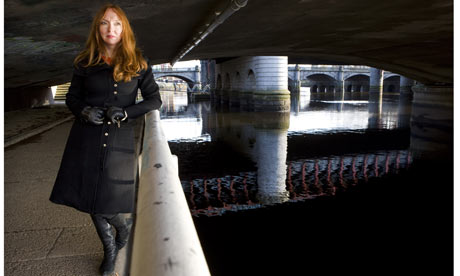
The award of the Turner Prize this year went to Susan Philipsz. Trained as a sculptor, she has taken the concept of sculpture as an art-form a long way - from even 50 years ago. Alberto Giacometti's sculptures are one of the most valuable artworks in the market right now, but it would arguably have been difficult for him to imagine sculpture leaning to the direction by Philipsz.
Susan Philipsz next to her exhibition "Lowlands Away" - 'singing as a sculptural experience'
Her concept of 'sound sculpture' is interesting in its absence of tangibility - essentially you can sculpt with sound. A bare room with speakers on a few walls. This concept of art as visual nothingness - is an area I do not profess to know much about, but in my mind represents an awkward direction in the investigation of the limits of art and how it can be represented. As with traditional sculpture, where the contours of a statue would be carefully carved, sound waves similarly shape the room with echoes and by responding to their physical surroudings.
Poetry can be found in the transmission of sound, just as colour and form represent the tools to illustrate the natural rhythm and harmony within a painting.

Nobel - An Institution

Sartre: Said no to the coveted Nobel Prize
Jean-Paul Sartre declined the 1964 Nobel Prize in Literature because he did not want to be "institutionalised".
From its beginnings in 1901, the Nobel Prize has come to be recognized as the pinnacle of any literary or academic career. No one during Alfred Nobel's lifetime had expected him to give the majority of his assets away to set up a foundation; he had, after all, made a fortune out of gunpowder. But his business prowess was balanced by a deep interest in the arts and sciences.
Alfred Nobel (born in Sweden, raised in St Petersburg, resided in France, the US, and Italy): inventor, entrepreneur, 'peace-lover'
But perhaps what has been the most politically controversial award is the Nobel Peace Prize, which reflected Nobel's own aversion to war. The last two awards in 2009 and 2010 have received much media scrutiny in recent times - which leads me to pose the question: why should such a politicised award be so important?
Nobel's own reasoning may be that having furthered so greatly the progress of military technology, one would realize the devastating effect of weapons that war in the future would be impossible. But what of the award now?
Bertha von Suttner: heavily influenced Nobel's thoughts about the necessity for peace in the late 19th/early 20th century, a period fraught with the possibility of large-scale military conflict.
Unlike the other Nobel awards, the Peace Prize is decided by just five members of a committee made up from former members of the Norwegian Parliament, despite all other awards being the responsbility of the Swedish Academy. Although the members are supposed to represent the broad spectrum spanning Norwegian politics, this is nonetheless a closed group - reflecting the uniquity of a nation outside the EU, with one of the highest standards of living in the world, the biggest public pension fund in the world, an oil/gas power, a key strategic power in Scandinavia, and one seemingly prominent in the study of global security. Although nominees are chosen by members of state, national courts, select academics, former winners, and other advisers, information about the nomination process (names of nominees, nominators, investigations, opinions) are, by statute, not disclosed for 50 years.
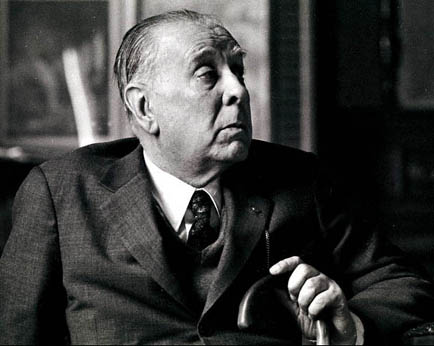
Jose Luis Borges: the only blot on his illustrious CV was the Nobel Prize in Literature, which he very much coveted.
One of the criticisms levelled at WikiLeaks at the moment is one which criticizes the focus being the US - and not more secretive states such as Iran, Israel, Saudi Arabia or China. But I wonder what they would find in the Nobel Foundation. How Jose Luis Borges did not fit the criteria of an author with 'idealistic tendencies'? Or an assumption that  Barack Obama would be more decisive in the global arena in ensuring both traditional and newer forms of security?

See relevant links:
Alfred Nobel: Biographical Information
Nobelprize.org - Nomination and Selection of Peace Prize Laureates
BBC: What the Nobel storm says about changing world powers

Monday, 6 December 2010

I'm in the pink

[pingk] Show IPA

noun, adjective, -er, -est.

–noun

1. a color varying from light crimson to pale reddish purple.

2. any of several plants of the genus Dianthus, as the clove pink or carnation. Compare pink family.

3. the flower of such a plant; carnation.

4. the highest form or degree; prime: a runner in the pink of condition.

5. ( often initial capital letter ) Also, pinko. Slang: Disparaging . a person with left-wing, but not extreme, political opinions.


–adjective
9. of the color pink: pink marble.

10. Slang: Disparaging . holding, or regarded as holding, mildly leftist views, esp. in politics.

—Idiom
11. tickled pink. tickle ( def. 10 ) .

Sitting at one of the row of computers in a room with absolutely no insulation, a girl walks in wearing a light pink hoodie, carrying a hot pink gym bag across her arm and reeling a deep pink suitcase.

In my combination of beige, royal brown, navy blue and claret, I look upon her path with a certain distaste; just excessively girly or massive fashion faux pas. She probably has a large placard with her at all times stating, 'Look at me, I am very feminine! <3'
Different shades of pink - between red and magenta
As David McCandless' Colour Chart shows, colours are attached different meanings in various cultures, but that curious mixture of white and red is an interesting phenomenon. It seems pink was first assigned gender-specifically in the early 20th century, but pink - as analogous to red - being a masculine colour. But since then, of course, it has evolved in a myriad of different spheres - most notably in ascribing femininity.

But a quick flick through Wikipedia and dictionary.com shows it has been used for the Financial Times, breast cancer campaigns, LGBT (alternative sexuality) issues, sensuality, 'mild' political leftism, and even a name of a popstar.

In these modern times where the discussion concerning gender becomes more translucent and lucid, the colour pink has been reclaimed by a masculinity trying to redefine itself. Comfortable with their 'softer' side, it is not unusual to see businessmen in pink shirts buried under a wrap of salmon pink which is the FT. So far I have not been inclined to wear a shirt blessed with a pink tinge of some sort; it is far too multifaceted in its meaning/and 'a little poststructualist' for my liking!

* I have been implicitly criticised for not going deep enough into issues of gender. In English culture, how is wearing pink for men more socially acceptable than it used to be - confidence yet sensitivity is one answer, another is the 'preppy' Ivy League look. In the absence of further research demanded by anthropoligists, here is a link to another essay on masculinity in the 21st century.

Friday, 3 December 2010

"Is that black bin not orange?"

Where is the colour black...? It's harder trying to find Wally.
This absurd question was directed to our class many moons ago in our first art class at secondary school. We could have gone for a Monet or a Gainsborough, but no... straight in at the deep end with some abstract nonsense I didn't understand back then.

"We've got a fruitbat of a teacher here, guys..."

Mr. B was tall, thin, and a little serious, but this did not excuse the luminous monstrosity that was the top half of his tracksuit. And he cycled with proper cycling shoes on (what is that all about...). Even during those cold winters. Art was supposed to be inspiring and creative, but he spoke with a controlled tone through a measured delivery - it was so focused that you would have thought art was more about discipline than idleness.


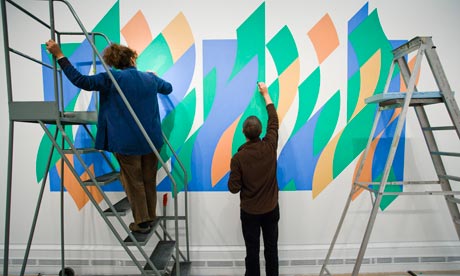
But aside from that question which boggled everyone's mind back then, he did introduce us to Bridget Riley. And now a few leap years later, she has returned to prominence with a small exhibition at the National Gallery, re-introducing me to those vaguely familiar thoughts of energy, colour and space.


Juxtapositioned with art of a more classical variety which had influenced Riley in her artworks - including Seurat, Mantegna and Raphael - her artworks suddenly made more sense. I am no art buff, but even those older paintings had an energy and rhythm which was hard to miss.


It is a testament to the vibrancy of art exhibitions which can continue to re-invent, and make us question what art fundamentally means and what it is supposed to represent. So the National Galley does Riley, and the Tate Modern does Gauguin - some people may think it should be the other way round!

See relevant links:
BBC Video: Bridget Riley at 80
National Gallery: Bridget Riley - Paintings and Related Works

Tuesday, 30 November 2010

Riding the Wikileaks Wave

The recent developments surrounding Wikileaks has put Julian Assange back in the spotlight. The 'computer hacker' with a 'peculiar' sort of intelligence can now be seen as the figurehead of the Wikileaks project, with more hard-hitting leaks to be exposed in the near future.

As is to be expected, typically libertarian-angled, user-generated news websites have caught onto this fervour of excitement. And one of the more interesting links was to Assange's supposed, old blog. It is fascinating reading and gives us an insight into the development of a figure willing to take on the most powerful institutions in the world.

Here is a link to Assange's IQ.org.

His personal take on rights is particularly interesting, and is indicative of his view that technology, as opposed to the rule of law, is the defence he primarily relies on: 

Sun 18 Jun 2006 : What are rights anyway?

"Rights are freedoms of action that are known to be enforceable. Consequently there are no rights without beliefs about the future effects of behaviour. Unenforceable general rights exist only insofar as they are argumentation that may one day yield enforcement.
Hence the Divine Right of Kings, the right of way, mining rights, conjugal rights, property rights, and copyright.
The decision as to what should be enforced and what may be ignored is political. This does not mean that rights are unimportant, but rather, that politics (the societal control of freedom) is so important as to subsume rights.
Politics emerges as the expression of the battle between our collective desires and strengths. Due to the common nature of mankind, there is great commonality in some of our strongest desires. When these desires do not compete they drive politics forward to ensure their fulfillment. This is what we usually mean by the capitalised Right, a powerword, a threat of collective enforcement." 

See relevant links:
Forbes.com: Interview with Julian Assange
Huffington Post: The Secret Diary of Julian Assange

Sunday, 28 November 2010

'Cause thats just the way it is

Wanted to live a 'normal' life away from monarchy: Edward VIII and his wife, Wallis Simpson.
There are many questions which prompt the answer in this title, but none more so than the historical reasons behind the existence of the monarchy in Britain. A fellow blogger has questioned the need for monarchy, and its relevance to our modern society today. I suppose its the nostalgia for 'Great' Britain, for tradition, for legacy, for quintessential Englishness.

While several Commonwealth countries in recent years have complained about the persistent presence of the Queen in matters of formality, many Americans are fascinated by the idea of monarchy. Is it because Americans yearn for some kind of divine historicity that the artificiality of their democracy cannot replicate? Isn't this what attracts the hoards of tourists to Buckingham Palace every year - the monarchy's empirical claim to power and symbolism of a nation?
What is the point of this man aside from heading a few trusts and foundations?
But as few care to recognize, major public events concerning the Royal Family is a delicate and precise PR exercise. Noone remembers the constitutional crisis when Edward VIII abdicated from the throne, nor does anyone want to acknowledge the fragility of the monarchy after the death of the 'People's Princess' in 1997 - how could the Royal Family be perceived to be compassionate and humane to a woman divorced from the monarchy but with a strong affinity to the public?

So as people celebrate the national holiday of April 29th next year, the thought will come to some about the bizarre and unusual circumstances which have made the survival of the monarchy possible in an age where republican government defines the majority of the leading nations around the world.

The mining deaths that (nearly) spoiled the fairy tale

Refusing to be immortalised in painting: Francis Bacon's 'Three Studies of Isabel Rawsthorne' shows the sitter as a shifting, pulsating mass of raw flesh. Bacon is depicting life, only if at the same time exposing the threat to it.
The Chilean miner story gripped cafes, offices and homes around the world with a story spun to reflect the hope and resilience of mankind. It would not be overblown to say that there was a type of media 'euphoria' surrounding the event and immediate aftermath with 'live coverage' and exclusive first interviews with the survivors.

But let us consider the less extensively reported incident of the mining incident in New Zealand where 29 miners died. Was it perhaps less significant because there was four less of them? Or maybe because as a 'media story' it just didn't have any legs at all?

If the media were so moral enough to cover the story in Chile which reflected compassion and unity, why did it do so to a lesser extent in New Zealand? Everybody recognizes the need to respect privacy in times of vulnerability and sensitivity but this is somewhat skewed by the fact that the 'amazing celebration' of survival supposedly merits the need to satisfy our own curiosity about these men who are 'models of solidarity' through continuous news stories, while the families affected in New Zealand have not faced the same incursion into their private lives. They certainly have not stood looking mesmerized in the middle of an 80,000 crowd at the Bernabeu Stadium in Madrid, thousands of miles away from home.

Mortality is something journalism does not deal with all too well; nor does it want to depict the inner life of tormented, wounded man - as Bacon so poignantly does. As with any narrative being consumed by mass society, the story has to be simplified and easy to understand; the initial despair can be forgotten by the dominating euphoria that follows an incident such as this.

Speaking of the masses, let us have one final thought for the many unreported, anonymous deaths related to heavy industry incidents. For example, do we know any of the names of those who died during the BP oil disaster? More significantly, China's infamously dangerous coalmines are getting 'safer' with just over 3,000 deaths a year compared to a peak of close to 7,000 in 2002 - what does this say about the perception of the Chinese individual. Perhaps they are just a few of many sunflower seeds which are all seemingly identical.

See relevant links:
Bloomberg: NZ mining incident and the industry in general
The Economist: China's dangerous mines
Chile miners: Rescued foreman Luis Urzúa's first interview
A fellow blogger's take on the Chilean mine story
Wikipedia entry: Francis Bacon

Saturday, 20 November 2010

Watch out: China might become the next Japan

Political activism in the arts can prevent China becoming a 'Japanese' materialist society
Ai Weiwei: wants China to follow its own destiny - not a globalized/Japanese path.

Ai Weiwei has made a big splash in both artistic and political circles in the UK recently, following his Sunflower Seed exhibition at the Tate Modern. His significance has been further accentuated by the British government's 'trade mission' to China, where the issue of human rights was believed to have been raised. There is no doubt that the British are lagging behind in terms of trade partnerships with China - Germany for one has become a valuable partner for the Chinese both in terms of investment, exports, innovation and knowledge. But this masks the political and human concerns which have been expressed by many in the British media and also by  the likes of Ai and the Swedish Academy.

Liu Xiabo - Nobel Peace Prize Winner: probably does not know that the UK trades more with the Republic of Ireland than all of the BRIC countries put together.
 China's relations with the outside world is predominantly looked at from a political economy point of view, and the effect of modernisation on China's society, and in essence its psyche, has been frequently overlooked. The debate has been particularly skewed by the US v China contest which leaves the intellectuals in the humanities - especially in Europe - grasping at straws. Aside from currency rates, trade deficits and globalised capital, one must look further into where China is heading socially.

The Sunflower Seeds exhibition has an overtly political message.
This is where artists such as Ai Weiwei become significant in his standing as a social critic for China. It has been argued that the next stage for China's economic development is domestic consumption - but what will that mean for Chinese society - we are not talking about Porsche's sales revenue being propped up in China despite disappointing sales in the rest of the world.

For neighbouring Japan, Ai Weiwei's political message seems explicit, harsh, rude and somewhat anachronistic. But despite the differences in their recent histories, it is evident that China will follow Japan's footsteps towards a materialistic, consumerist society. A shallow one where Deng Xiaoping's words will ring true: 'to become rich is glorious'.

The Tiananmen Square 'Incident' in 1989 is now just a small blip with regards to the overarching upwards curve of China's progress to a world superpower. It seems nothing has been learnt about their cries of Science and Democracy - however excessively 'Westernized' those views were. These values matter now because Ai and Liu Xiabo recognise that the Chinese population are sliding into becoming a mass of 'docile bodies' - entranced by a materialist lifestyle; unable to escape the shallow life which accompanies the hoarding/ownership of things.

This is why I have some reservation about the works of the celebrated Japanese artist, Takashi Murakami. There is some validity in his reaction against the traditional styles of Japanese art which are still celebrated by the West - the Kuniyoshis and Hokusais of this world; but he is embracing the strange and wonderful that is the product of Japan's docile-ness. The otaku culture which he explores is a cultural phenomenon unique to Japan, but despite its sense of playfulness, it illustrates the shallow, closed nature of Japanese society.

Now that's what I call juxtaposition: Japanese pop art inside the symbol of the French establishment
Murakami's current exhibition in the Versailles Palace, France, is certainly provocative - the conservative strand of the French artistic establishment are certainly not happy - but perhaps this reflects the French perception of Japanese culture as embodying an esoteric civility. Furthermore, Murakami's close links with fashion and the marketing of his 'brand' is one which reflects the modern world, rather than commentating on it.
Consumerism is fast becoming king for the affluent Chinese. Is this a sign of an emerging society which is ultimately shallow and vacuous?
Of course the political instability in the China of today can be contrasted with that of the Japan's relatively peaceful, post-WWII rise shepherded by the US, but the political and social commentary of many Chinese avant-garde artists should not be lost. Progress and prosperity in the material sense should be no excuse for activism and critique to be wholly replaced by reflection and humour.

If China wants to develop its national identity distinct from the current Japanese one, it must recognise the value of its rich cultural heritage and encourage its arts to evolve freely. Germany has the Goethe Institute but also has the modern dynamism of cities such as Berlin. China has the Confucius Institute but no shining beacon of modern art  which is celebrated by the wider population - just the 'commercialised' 798 art district in Beijing and Monganshan Road in Shanghai. It is clear that the recent astronomical sales of Qi Baishi's works do not bode well for the future development of modern Chinese art.* Thus Ai Weiwei and others like him feel a sense of responsibility to preserve and develop the Chinese psyche by engaging with the population at a higher philosophical level. This needs to be further encouraged.
The one-dimensional economic perspective of China in the West is too pervasive and not exactly helpful.
We should look beyond the stark economic figures when assessing a nation's progress. Even India - another one of the BRICS - is embracing modern art (as seen at the Saatchi Gallery earlier this year). Most of the exhibiting artists did have a socio-political message - which sometimes too explicit - showed a concern for the effects of rapid economic development in other human spheres.

The art world, let alone the world in general, does not need a Chinese version of Murakami in the future. Not only would this reflect the glory of the global market in all its manifestations, but it would be rather uninteresting too.

* Qi Baishi was third last year in terms of worldwide sales behind Warhol and Picasso.

See relevant links:
BBC: Cult of Less
Takashi Murakami at the Palace of Versailles
Saatchi Gallery: The Empire Strikes Back - Indian Art Today
798 Art District in Beijing
BBC iPlayer (for UK only): Imagine - documentary on Ai Weiwei
Telegraph: Obscure Chinese painter Qi Baishi is third top earning artist

Tuesday, 16 November 2010

'It's so Brechtian' - whatever that means...!


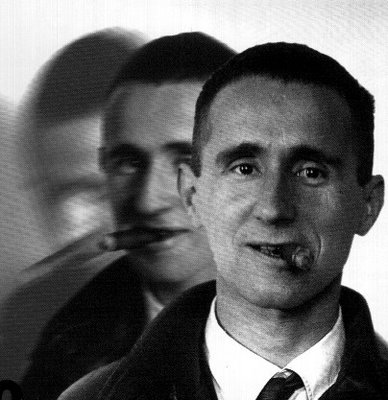
Bertolt Brecht is a name renown in German literary circles to this day in his stark criticism of contemporary society and the capitalist economic model. He was a lifelong committed Communist, but this should not mask his contribution to theatre.

His play, 'The Good Man of Sichuan', sticks in my head as a wondrous morality tale which combines the Western ideas of morality and goodness with an Oriental visual flair. As with Sichuan opera, the techniques of imitation and shifting masks provide the perfect background for the protagonists struggling to find integrity in a life beset by deceit and poverty.

The starkness of Brecht's epic theatre is also reflected in his 'Mother Courage and her Children'. The mercenary nature of the capital driving warfare is a central theme here, where the drive for revenue continues unabated for Mother Courage despite the death of her sons. Brecht's plays would not be his without a hint of political anger, but his famed Verfremdungseffekt deserves greater recognition in our era which is very much emotionally driven by others. Brecht brings out the rationalist in us, regardless of our political affinities.

Perhaps it would be no bad thing to be more 'Brechtian' in our day and age, even if that means nothing more than to know more about and read a bit of Brecht's impressive works.

Next up: Orwell

Warning: this will be biased since I have only read J.M. Coetzee's 'Diary of a Bad Year' while I have read most of Orhan Pamuk's English-language titles.

The Essayist is a strange phenomenon in this day and age where the columnist and the social commentator appearing on our TV/computer screens dominate the scene for 'expert' opinion. Even the Blogger can have some sort of influence in an increasingly crowded market of visible opinions.

But in the form of J.M. Coetzee's 'Diary of a Bad Year' and Orhan Pamuk's 'Other Colors', we have two collections of essays of the highest order. Although their styles are vastly different, the commentaries on daily life, both trivial and sombre issues, and higher philosophical machinations combine in a way that we cannot not be influenced by their words.

In the red corner: arguably Turkey's finest writer, Orhan Pamuk 
Let us take Orhan Pamuk's 'Other Colors'. His is an honest voice, observational but undoubtedly a masculine one. Having come from a comfortable background, he seems to be confident in his sentimality and integrity; an unabashed social commentator who has (inadvertantly) found his own Western-facing political tone. Occasionally he will veer into the vulgar masking a deliberate playfulness, but his essays are solely his own. Writing about his daughter Ruya, this is a man who is comfortable with family life and more generally, with the wider pubic in essence.

In the blue corner: J.M. Coetzee - an authentic voice spanning the British colonial diaspora
J.M. Coetzee's publication undoubtedly has a very different format with his short essays accompanied by a story running on the bottom half of the page with two narrative voices, one being a writer closely resembling himself, and another being Anya, a young woman who becomes his typist. His political landscape centres on South Africa, the US and Australia but what is more distinctive is his apologetic, almost guilt-ful tone. Perhaps coming from the shame that manifests itself from a voice inflicted by post-colonial/apartheid white-man's retrospection, this reflects Coetzee's public persona as a reclusive professor type with 'monkish' self-discipline. By having a separate story which comments on his opinions written on the top half of the page, the writer - which is Coetzee in his different guises - is so apprehensive and unsure of his opinions that doubt creeps into the reader about what would ordinarily be 'high-minded' opinions. There is a deliberate self-consciousness about the writer which transposes onto the reader, which suggests this is still the genre of fiction - just.

I hope publishers continue to publish essays like these, because the essay format threatens to be the most truthful and revealing way of showing one or more sides to one's public persona. As they are both Nobel winners, it is obvious that their essays command some respect; but writing fiction with imagination and writing essays with insight are two very different things.

Next on my list are the essays of George Orwell. How will his voice compare to the two mentioned here?

Sunday, 7 November 2010

Pirates - still a pain in the legal backside

Pirates have been around for donkey years (as long as Peter Pan at least) but the law still hasn't really caught up with them.
Ah, those Somalian devils. With an AK47 slung across their back, they count the cash which probably came via DHL from London. Lloyds' of London - ever since its inception in a small coffeehouse in around 1688 - has led the insurance sector into securing against pretty much anything - vocal chords, hair, space flights and of course pirates. But why has international law lagged behind in attempting to punish these outlaws in the Gulf of Aden?

This BBC article shows how difficult it has been to get international consensus on how to convict captured pirates. Which laws? Which jurisdictions? Which due processes? Without money, time and most importantly political will, the steps towards a trial and conviction will continue to be painfully slow.

Of course there must be impartiality before the law but the pirates have got major international powers into a political quandary. With the US, EU, China, Russia - among others - having a vested interest into the safe passage of cargo ships in the area and the criminal convictions of those thwarting this business, it will only be at the political level that any legal processes can actually work.
Lloyds' of London: where pirates get most of their hard-earned ransom money from.
It was also revealed by the BBC a few months ago, that the British government is actually blocking a sanction at the UN to take action against two suspected pirate organisers. This is nothing to do with human rights; this purely hinges on a legal technicality - in the UK, paying a ransom is not a criminal offence. Coming back to the famous Lloyds' insurance, I wonder how much they are responsible for this particular legal development - since most ransom negotiations with the pirates currently go through London?

But this opens up a wider question on jurisprudence in the developed world. International law is comprehensive enough but by no means anywhere near pervasive or complete, and frequently relies on political nous to work at a practical level. Furthermore, when the laws of the developed West clashes with those in the less developed world - where talk of legal culture is much more widespread than law in its strictest sense - it can cause widespread problems. Observers of the wealthy Gulf states would know that 'petro-dollars' have a considerable influence as to how law in these countries is being developed. Borrowing bits of English and New York Law, commercial transactions laid forth by legal whizzkids have to skilfully skirt around the traditional condemnation of debt and interest in Islamic law and finance.

Whereas the West likes to think that it works by democratic consensus, institutionalised safeguards and with due process, it is struggling to understand how developing countries with astronomical growth rates could laugh at this rule-of-law 'drivel'. The Chinese especially have quite a different view on what the law means. Their Legalist school of thought is particularly revealing - which advocates for a common focus on strengthening the political power of the ruler, of which law is only one part. You won't see (m)any Chinese quoting from their Constitution which advocates freedom of speech or religion!
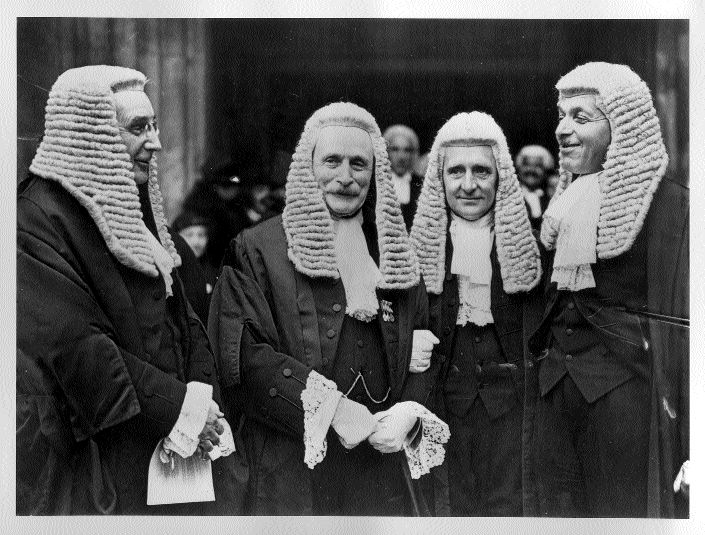
It's not only wigs that makes the law as we know it look a bit ridiculous sometimes.
The West has long prided itself on its economic power and legal integrity, but for all its development in the philosophies of law, society and politics, those pirates are still finding enough loopholes for a few people in the political/legal elite to look a bit silly.

Incidentally, I wonder what pirates think of the law? I'm not sure but they might be smiling like this:


See relevant links:
Wikipedia entry on the Chinese philosophy of Legalism

Friday, 5 November 2010

Too lefty for my Liberalism

The political spectrum 'circle'
As history has taught us, the extremities of the left and right wing are not actually too far apart. The pendulum had swung quite nicely to the left in Atlantic politics until a few years ago. New Labour governing for over a decade in the UK, and Obama becoming Europe's favourite US president for absolutely ages.

But in these austere times, the liberals are questioning what went wrong. The web is littered with articles trying to put some perspective into the success of the Tea Party movement, and questioning the legitimacy and integrity of the left wing in the developed world. And furthermore, you have China and Brazil championing national champions in their meteoric economic rise - just to rub salt into Western wounds.

My last words today are 'borrowed' from the Maverick Philosopher's excellent blog entry. It is uncomfortable to stand unflinchingly for convictions that I accept as only relatively valid; one must utilise conviction and flexibility reflexively to aim towards moral and political maturity.

Here is a selection for you to enjoy, if you don't know much about it already:
The increasingly complex politics of Climate Change
Happy Meals being banned in San Francisco
YouTube: How Liberals Argue
Maverick Philosopher blog - Conservative Activism, The Left's Incomprehension, and the Genetic Fallacy (2010 Version)
Stumbling and Mumbling blog - Dobbs Paradox

Language in its modern guise - Pacific Asia focus

"Do you want a burger? Do you want some beef?!"

'Beef' means 'to have a fight'
Further to my last post on language, it is also revealing to see how slang, colloquialisms and text-speak have influenced our perception of language. It is not just management speak like "ideas showers" (because obviously its so un-PC these days to say brainstorm...), "going forward" and "in the pipeline; the transformational role of technology must also be considered in the evolution of language.

As is popular in most parts of Pacific Asia, SMS's are littered with :-), :-s, (^_^), (*_*) and other quite amusing symbols. Whether this has got anything to do with the historically pictographic nature of the Chinese or Japanese languages remain to be seen.

Furthermore, the following web page shows how Chinese bloggers and net-izens get around China's notoriously stubborn internet firewall. While the government there employs "5 Yuan warriors" (an army of computer geeks to censor unsuitable online materials for $0.75/£0.50 per site), the younger contingent of China's 1.3 billion population are finding ingenious ways to get around the system and talk about things most Western youngsters freely do.

For example, while we say 'po-po' for the police, the youth in Greater China rely on the introduction of 'pinyin' in the Mandarin language: 警察 = jǐngchá = JC. Pretty clever, right? ;-)

Writing authority: the diverging rules of law and language

 
Contrasting the rules of language which govern legal certainty and post-structuralism

As any law student will know, understanding language in all its precise and pedantic forms is an essential skill for their career path. When one has to advise a client, it is important to understand the probabilities of how legal procedures play out and what is the best course of action to take. Thus the interpretation of language is key to convicting someone or getting multi-million dollar damages.

I am no linguist (in the scientific sense of the word) but it strikes me as peculiar how the law student will try and ascertain the legal certainty of language, while others in the humanities are busy breaking it down to find new meanings in texts. Although it is difficult to believe fully in the 'death of the author', it is evident that text is removed from its author to a certain extent. Especially when it comes to the advertising billboards that we see every day, this is their purpose - to remove themselves from the author and delve piercingly into the observer's mind.

Furthermore, the study of literature is enriched by multiple, overlapping meanings. There are no restrictive rules like in the study of law where one learns the three key rules of language (literal/golden/mischief rule); there is no real purpose to a strict understanding of the text in literature, whether it be in a personal or commercial setting. It is enriching - not distracting - to have many interpretations of the same words. The reader of the novel is worried about the relationship between him and the words in front of him; one wants to get swept away in an entrancing discourse far removed from the hard-nosed considerations of certainty and risk-management.

But the key difference between the development of legal and literary language is this. While authority in a legal document is ascertained by its link to the force of the law and the State, authority in literature is at its strongest when the author is unaware of it. Writers have no natural wisdom but their words have most authority when they themselves are not conscious of the power of their writing.

Wednesday, 27 October 2010

Technology and Human Nature - Only One Key Difference

Are you a hawk...
Technology and Human Nature agree on two common things which drive them on: sex and food. But curiously, it seems the third key ingredient is somewhat different: for technology it is warfare; for human nature it is sleep. How odd...

... or a dove?
Peter Nowak's book 'Sex, Bombs and Burgers' details how 'war, p*rn and fast food created technology as we know it'. While William Saletan on his Slate.com 'human nature' blog says initially that sleep must be the most important out of the three. Technology and human nature - how they must co-exist!

See relevant links:
Festival of Ideas: Peter Nowak
William Saletan's blog on Slate.com

The Rise of the Pre-nup, Partnership and Platonic

The Frenchman and German heiress who fundamentally altered English divorce law
The Granatinio/Radmacher divorce case is being called a landmark case, as it suggests that pre-nuptial agreements is now a legal document that can be used legitimately in English courts. The particulars of the case - a French ex-banker/Oxford don who had married a beautiful German heiress - certainly had many divorce lawyers observing with great interest. Because evidently London is the divorce capital of the world, right?

But apart from the legal implications of the case, it is important to consider the wider dynamics between male and female in society. From one angle it seems that England and the rest of the U.K. is heading towards the recognition of the pre-nup like in the U.S. - increasingly the romantics associated with the institution of marriage are becoming eroded, and replaced by legal ramifications, joint bank accounts and tax breaks. But it can also be argued that the pre-nup - while making the institution of marriage fairer and more equal to both parties - automatically introduces a sense of distrust to a relationship. "What do you mean you love me more than anything, but you're still afraid I will take off with all your precious assets?"

And to complicate things, whatever will happen to White v. White, which set the precedent for courts to consider first an equal, 50-50 split of assets between man and wife?

Divorce - the ultimate high-stakes poker game
The institution of marriage in modern times seems just a little troubled, given the devil-may-care attitude to it. I can always divorce. And in ideal situations, separated parties can maturely settle arrangement which makes the process of falling out of love with someone a less stressful transition. But it is unfortunate how adults quickly and easily change to behave like children over spilt milk. Hate, I feel, is a rather strong word, but it gets bandied around quite a lot in the fiery, high-stakes poker game that is a divorce case.
"I now pronounce you partner and partner"
Some argue that marriage is an anachronistic institution unsuitable for our times - how about we all try the civil partnership? The legal and financial security of marriage is still there, but the civil partnership model for some reflects a more tolerant, equal society. With religion, patriarchy and other sources of tradition sweeping us by, it has been suggested that husband and wife should be replaced by partners. I have always wondered what people mean when people say, 'I live with my partner'. Is the Oxford American Dictionary correct in its definition of a 'partner' as 'either member of a married couple or of an established unmarried couple'? This is the background of those in the UK who are pushing for straight-sex civil partnerships, which are currently forbidden here.

Best fwends a.k.a BFF: The first image that came up when I google-image-searched 'platonic friendship'
And finally we must consider the rise of the Platonic friendship. For centuries before our own, a friendship between a man and woman was unheard of, or at least very much frowned upon in all cultures and societies around the world. Our biological traits showed us to be incompatible apart from our natural instinct to reproduce and extend our bloodline. In most societies in the West, Platonic friendships between a man and a woman is taken for granted. We are supposed to be very comfortable with just hanging out with the opposite sex and not have an iota of sexual attraction for them. Some people have rubbished this concept - it doesn't exist, they say. Of course, things are never as simple as they seem to be, but it is food for thought that the progress of modern society is inconsistent, incomplete and less universal than we assume.

The picturesque boarding school where Prince Charles schooled. Cold showers, early morning runs and bullying - the healthy diet which old-fashioned education establishments thrived on in the past. 
Just ask those poor ex-boarding school pupils who make up a healthy chunk of clients for shrinks!

See relevant links:
Financial Times - UK court upholds pre-nuptial deal for heiress
BBC - Why would a straight couple want a civil partnership?
Slate.com - The story of a platonic friendship
The family law case of the decade: White v. White

Wednesday, 20 October 2010

The integrity of postmodernism - colouring shades of grey

'Structures don't protest on the streets'

The origins of poststructuralism in Paris in 1968 led to a revolution in intellectual thought as the established rules of language, institutions and norms came crashing down. This indeed seemed like putting the final nail in the European Enlightenment coffin; intellectual thought would never be the same again. And as they say, the rest is history.

Now it seems that postmodernism is the dominant force in our society as there can be meaning in anything and everything at the same time. Hyper-relativity of today's instant media makes it doubly difficult to find truth and essence. Imitation, repetition, globalisation - these are the forces which have dumbed our senses down but show no sign of their influence abating. We are at a loss to find that precious needle in the haystack.

Anish Kapoor's 'Tall Tree and the Eye' - filled with clear meaning?
You look at a sculpture and wonder what it possibly could be. Without a caption, you might actually be a little miffed. Is this 'good' art when the explanation seems unnecessarily convoluted? Is obtusity the name of the game - a new kind of elitism where the brash confidence of the individual as a brand is celebrated in the full glare of the media? And it is open to question whether we would all agree with J.M. Coetzee's assertion that:

'In the present "culture", few care to distinguish - indeed, few are capable to distinguish - between sincerity and the performance of sincerity.' (Coetzee, 2007)

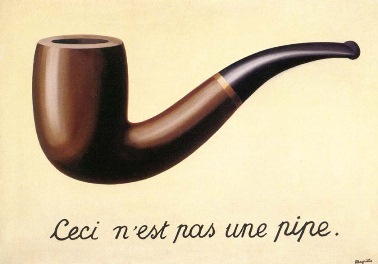
Rene Magritte's 'The Treachery of Images' - this is not a pipe, but an 'image' of a pipe
But this does not mean that the postmodern project is a futile one; we should not be writing its obituary just yet. As with any quality cultural or intellectual pursuit, the process must be rigorous and open to scrutiny. Only then can we sort out the rainbow of colours from the shades of grey.

Otherwise we might get the laughable stupidity of America we all love to laugh about in Britain: 'The rise of Idiot America today reflects - for profit, mainly, but also, and more cynically, for political advantage and in the pursuit of power - the breakdown of the consensus that the pursuit of knowledge is good. In the new media... if everyone is an expert, then nobody is... That because there are two sides to every question, they both must be right or at least not wrong.' (Pierce, 2010: 8)

Idiot America has seeped into popular culture through the music of Green Day
Of course the British would never admit to have plunged to such dire intellectual depths, but it is a possibility - especially for the docile population to embrace their own 'chav'-ocracy. Well at least we wouldn't possibly vote for someone like Christine O'Donnell, right?

Relevant links:
Guardian Review of J.M. Coetzee's Diary of a Bad Year
Google Books: Charles Pierce - Idiot America
YouTube video of Christine O'Donnell - "I did not go to Yale"

Sunday, 17 October 2010

Sunday Digest - Animated Lessons in Philosophy

The clear blue skies and sunshine betray the seasonal Gods. October is upon us and the cold wind hits you boldly in the face, waking you up from the dreamy sleep and the wine from yesterday. It's a Sunday, the day of rest - what better way to spend it than relaxing at home with the rays of sunshine filling the room with clarity and calm; with a laptop on your knees as you curl up in your favourite armchair. Then you might read a blog or watch something on Fora.tv.

You want to encounter ideas but not something that will crush your mind with depth or unnecessary complexity. You click on the link below and you are transported to an intelligent plain, thinking this is quite possibly the most engaging philosophy lecture you've ever seen.

Matthew Taylor: 21st Century Enlightenment Animated (Fora.tv)

You finish watching it, ponder, and perhaps a wide smile spreads across your face about the wonders of our world. :-)

See relevant links:
Cognitive Media UK's blog

Other good Sunday reads:
Slate Magazine including this article from Anne Applebaum
Kathryn Schulz's 'Being Wrong: Adventures in the Margin of Error'
Social by Social: A practical guide to using new technologies to deliver social impact
Benoit Mandelbrot talk at TED.com